AMC Mental Health MCQs: Psychiatry Revision and Practice
Mental health is 12.5% of the AMC CAT MCQ, about 19 of 150 questions, built around Australian Mental Health Act principles, risk and capacity, and safe prescribing. This hub gives you the monitoring numbers, legal tests and emergency distinctions to master, with worked questions and free practice.
Mental health is 12.5% of the AMC CAT MCQ blueprint, which means about 19 of your 150 questions will involve a patient with a psychiatric, behavioural or substance use problem. This AMC psychiatry MCQ hub sets out how the domain is examined, the Australian laws and guidelines the stems rely on, and the drug monitoring, risk and emergency decisions that come up again and again.
Australian psychiatry stems lean on state Mental Health Acts, least-restrictive care, capacity, safety planning and physical health monitoring, not just drug names. The sections below focus on those decisions.
Key takeaways
- Mental health is 12.5% of the blueprint: about 19 questions in a 150-item exam.
- Rule out organic causes first. Delirium, substances, thyroid disease and medication effects are regular "most likely diagnosis" answers.
- Every state and territory has its own Mental Health Act, but they share core criteria: mental illness, a risk of serious harm or deterioration, and no less restrictive option.
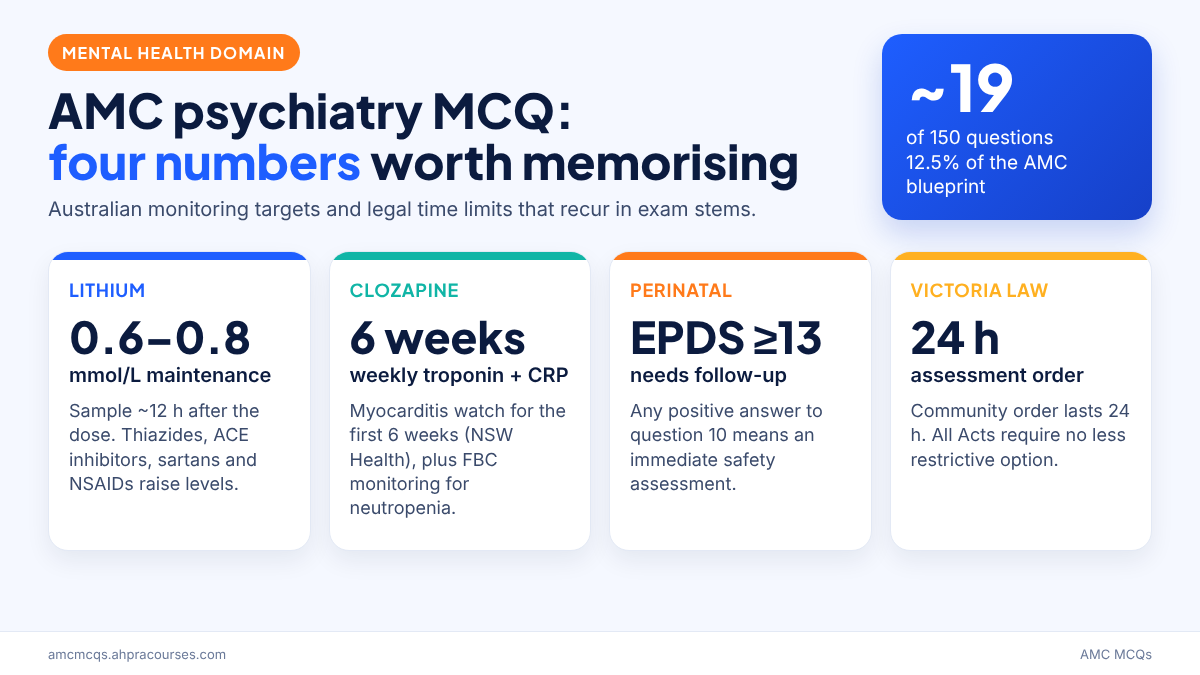
- Know the monitoring numbers: lithium 0.6–0.8 mmol/L for maintenance (12 hours after the dose), clozapine troponin and CRP weekly for the first 6 weeks, and an EPDS score of 13 or more.
- Learn to tell apart the emergencies that look alike: serotonin syndrome versus NMS, lithium toxicity, delirium tremens and Wernicke encephalopathy.
How mental health is examined in the AMC psychiatry MCQ
A question belongs to mental health when the main problem is psychiatric, including child and adolescent, perinatal, old-age and addiction presentations. Each item has five options and one best answer, and stems are often long vignettes with a mental state examination (MSE) built in.
All three AMC clinician tasks are tested:
- Data gathering: the most important question to ask next, such as suicidal intent, substance use, a collateral history or a medication change.
- Data interpretation: the most likely diagnosis. Expect to separate depression from bipolar depression, delirium from dementia, and primary psychosis from drug-induced psychosis.
- Management: the most appropriate next step. Typical answers are urgent review, admission, starting or stopping a drug, checking a level, using the Mental Health Act, or arranging psychological therapy.
Several options are often reasonable; the best is the safest one that is also least restrictive. Watch for "first", "initial" and "most appropriate".
Assessment: the MSE, risk and capacity
Mental state examination and organic screen
Use a set MSE order (appearance, behaviour, speech, mood, affect, thought, perception, cognition, insight, judgement). Before a primary psychiatric diagnosis, rule out:
- Delirium: acute onset, fluctuating attention, and a reduced or clouded level of consciousness. Look for infection, drugs (anticholinergics, opioids, benzodiazepines), withdrawal, hypoxia, metabolic disturbance and urinary retention.
- Substance-induced states: methamphetamine, cannabis, alcohol withdrawal and steroid psychosis.
- Medical mimics: thyroid disease, hypercalcaemia, B12 deficiency, HIV and syphilis in new psychosis, temporal lobe epilepsy, and space-occupying lesions in late-onset or atypical presentations.
Suicide risk and safety planning
Ask directly about suicidal thoughts, plans, intent, access to means and protective factors. Asking does not increase risk. Australian practice favours a collaborative safety plan over simply labelling risk "low", "medium" or "high". In a stem, a person with a plan, intent and access to means, or with psychosis or command hallucinations, needs same-day specialist assessment. Reducing access to means (medications, firearms) and involving family or carers are expected parts of the answer.
Capacity
A person has decision-making capacity if they can understand the information, retain it, use or weigh it, and communicate a choice. It is decision-specific and can change, and a psychiatric diagnosis alone does not remove it. Lack of capacity for medical (non-psychiatric) treatment falls under guardianship and substitute decision-maker law, not the Mental Health Act. Consent principles are covered on the AMC population health and ethics MCQ page.
Mental health law in Australia: what AMC psychiatry MCQs expect
Each state and territory has its own Act, so stems test principles rather than section numbers:
| Jurisdiction | Principal legislation |
|---|---|
| New South Wales | Mental Health Act 2007 |
| Victoria | Mental Health and Wellbeing Act 2022 (in force from 1 September 2023, replacing the 2014 Act) |
| Queensland | Mental Health Act 2016 |
| Western Australia | Mental Health Act 2014 |
| South Australia | Mental Health Act 2009 |
| Tasmania | Mental Health Act 2013 |
| ACT | Mental Health Act 2015 |
| Northern Territory | Mental Health and Related Services Act 1998 |
The criteria for involuntary assessment or treatment are broadly similar everywhere:
- The person appears to have a mental illness.
- Because of it, they need treatment to prevent serious harm to themselves or others, or serious deterioration.
- No less restrictive means are reasonably available.
Two worked examples:
- Victoria: a registered medical practitioner or authorised mental health practitioner who has examined the person in the previous 24 hours can make an assessment order. A community assessment order lasts 24 hours. An inpatient order expires 24 hours after the person arrives at the service, or 72 hours after it was made, whichever is earlier. The authorised psychiatrist can extend it by 24 hours, up to twice.
- NSW: a "mentally ill person" is someone who, because of mental illness, reasonably needs care and treatment in a mental health facility to protect themselves or others from serious harm. The Mental Health Review Tribunal reviews involuntary patients, can make community treatment orders, and must approve ECT for patients under 16.
Exam tip: Substance intoxication, antisocial behaviour, sexual preference or holding unusual political or religious beliefs alone do not make someone mentally ill under Australian Acts. If a stem describes an intoxicated, aggressive man with no evidence of mental illness, the Mental Health Act is not the answer.
Mood disorders: depression, bipolar and perinatal
Depression
- Mild depression: start with psychological therapy (CBT, interpersonal therapy), activity, sleep and alcohol advice. Under the Medicare Better Access initiative, a GP mental health treatment plan gives rebated psychology sessions.
- Moderate to severe depression: an SSRI plus psychological therapy. Review within 1–2 weeks, and expect benefit over 4–6 weeks. Continue for at least 6–12 months after remission.
- Young people: psychological therapy first. If an antidepressant is needed, fluoxetine has the best evidence. Monitor closely for emerging suicidality early in treatment.
- ECT is used for severe depression with psychotic features, catatonia, refusal to eat or drink, or high suicide risk where a rapid response is needed.
Bipolar disorder and lithium
Lithium is the classic monitoring question. Australian Prescriber gives these targets:
| Item | What to know |
|---|---|
| Target level | 0.6–0.8 mmol/L for maintenance; up to 0.6–1.0 mmol/L in acute mania if tolerated |
| Sample timing | About 12 hours after the last dose |
| Early monitoring | Baseline, then at 7, 14 and 28 days; then 3, 6 and 12 months, then at least yearly |
| Other tests | Electrolytes, creatinine and eGFR; TSH; calcium (hyperparathyroidism) |
| Interactions that raise levels | Thiazide and loop diuretics, ACE inhibitors, sartans, NSAIDs; also dehydration and vomiting |
| Toxicity | Coarse tremor, vomiting, diarrhoea, ataxia, confusion, then seizures and arrhythmia |
Valproate should be avoided in women who could become pregnant because of its teratogenicity and neurodevelopmental effects. Antidepressant monotherapy in bipolar depression can trigger a switch to mania.
Perinatal mental health
The national perinatal guideline recommends screening with the Edinburgh Postnatal Depression Scale (EPDS) at least once, preferably twice, in both pregnancy and the postnatal year. A score of 13 or more needs follow-up. Any positive answer to question 10 (thoughts of self-harm) needs an immediate safety assessment for the woman and her children. Postpartum psychosis usually starts within the first 2 weeks after birth, and it is a psychiatric emergency that needs urgent admission, ideally to a mother–baby unit.
Psychosis and antipsychotics
- First-episode psychosis: rule out organic causes and do a urine drug screen, then start a low-dose second-generation antipsychotic. Involve early psychosis services, family and psychosocial support.
- Metabolic monitoring: weight or waist, BP, fasting glucose or HbA1c and lipids at baseline and regularly afterwards. Olanzapine and clozapine carry the highest metabolic risk.
- Treatment-resistant schizophrenia (no response to two adequate antipsychotic trials) means clozapine.
- Clozapine monitoring: NSW Health guidance is CRP and high-sensitivity troponin weekly for the first 6 weeks, to detect myocarditis, plus a full blood count through the brand's monitoring registry for neutropenia. Also watch for constipation (which can progress to ileus), seizures at higher doses, and sialorrhoea. Stopping smoking can raise clozapine levels, because tobacco smoke induces CYP1A2.
- Dementia: antipsychotics for behavioural and psychological symptoms of dementia increase the risk of stroke and death. Use non-drug approaches first. Risperidone is the TGA-approved option, short term, for persistent aggression or psychosis in Alzheimer's dementia.
Psychiatric emergencies you must separate
| Presentation | Clues | First steps |
|---|---|---|
| Serotonin syndrome | Rapid onset after a serotonergic drug is started, increased or combined; clonus (inducible, ocular), hyperreflexia, agitation, diaphoresis. The Hunter criteria were developed in Australia. | Stop the serotonergic drugs, give supportive care and benzodiazepines; cyproheptadine in moderate cases; ICU for severe hyperthermia or rigidity |
| Neuroleptic malignant syndrome | Days to weeks after starting an antipsychotic or increasing the dose; lead-pipe rigidity, bradyreflexia, hyperthermia, fluctuating consciousness, high CK | Stop the antipsychotic, cool, give IV fluids, and admit to HDU or ICU |
| Lithium toxicity | Vomiting, coarse tremor, ataxia, confusion, often after a new diuretic, ACE inhibitor or NSAID, or dehydration | Withhold lithium, check the level and renal function, give IV fluids; haemodialysis if severe |
| Anticholinergic delirium | Dry, flushed skin, dilated pupils, urinary retention, picking behaviour | Stop the cause, give supportive care; seek toxicology advice |
| Acute behavioural disturbance | Agitation with risk to self or staff | De-escalate first, then oral sedation, then parenteral; consider medical causes |
Anxiety, trauma, eating and personality disorders
- Generalised anxiety and panic disorder: CBT first. SSRIs or SNRIs are the drug options. Avoid benzodiazepines beyond short-term use because of dependence.
- PTSD: trauma-focused psychological therapy (trauma-focused CBT, EMDR) is first-line. Routine benzodiazepines are not recommended.
- Anorexia nervosa: medical instability is what decides admission: bradycardia, hypotension or postural changes, hypothermia, electrolyte disturbance, syncope, or rapid weight loss. The exact admission thresholds depend on the state guideline and on whether the patient is an adult or a young person. When refeeding, watch phosphate, potassium and magnesium (refeeding syndrome). Family-based treatment is first-line for adolescents.
- Borderline personality disorder: structured psychological therapy such as dialectical behaviour therapy, consistent care and crisis planning. Medication has a limited role, and polypharmacy should be avoided.
Alcohol and other drugs
- Alcohol withdrawal: starts about 6–24 hours after the last drink. Seizures are most likely in the first 48 hours and delirium tremens at around 48–72 hours. Use a structured scale such as CIWA-Ar, symptom-triggered diazepam, and give parenteral thiamine before any glucose to prevent Wernicke encephalopathy (confusion, ataxia, ophthalmoplegia).
- Alcohol limits: the NHMRC advises healthy adults to drink no more than 10 standard drinks a week and no more than 4 on any one day.
- Opioids: naloxone reverses overdose, and take-home naloxone is available free in Australia. Opioid dependence is treated with methadone or buprenorphine (including long-acting injectable buprenorphine) through state opioid treatment programs.
- Methamphetamine: causes psychosis, agitation and hyperthermia. Treat with sedation and safety measures, and screen for cardiac complications.
Common traps for IMGs in AMC psychiatry MCQs
- Using the Mental Health Act too early. If a voluntary admission or community crisis team is a safe option, it is the less restrictive and better answer.
- Missing delirium in an older inpatient who is "suddenly psychotic".
- Starting an antidepressant alone in a patient with a past manic episode.
- Not checking a lithium level when a stem mentions a new antihypertensive, diuretic, NSAID or gastroenteritis.
- Treating NMS as serotonin syndrome, or the other way round. Clonus and rapid onset point to serotonin toxicity. Rigidity, a slower onset and a high CK point to NMS.
- Forgetting the children. In perinatal and parental mental illness stems, the safety of the children is part of the answer.
How to study mental health in our question bank
The question bank holds 3,000 original questions weighted to the blueprint, so about one in eight is mental health. Each comes with a full explanation of every option. A plan that works well for psychiatry:
- Learn the frameworks first in tutor mode: MSE, risk and safety planning, capacity, and Mental Health Act criteria.
- Drill the pharmacology subtopic: lithium, clozapine, antidepressant switching, and the serotonin syndrome versus NMS comparison. Write each wrong answer into your error log.
- Do timed mixed blocks at 84 seconds a question. Practise spotting the key fact (onset, drug change, risk) on first read.
- Use the domain analytics to target your weakest subtopics with drills, and redo questions you got wrong until you get them right.
- Sit the full 150-question mock so you know you can handle long stems late in the exam.
Start with 10 free mental health questions in the practice bank, see the packs on the pricing page, and plan your revision with the AMC MCQ study plan. The AMC paediatrics MCQ hub covers child development and adolescent assessment, and the topics hub links all six domains.
Worked AMC mental health practice questions
A 58-year-old woman with bipolar I disorder has been stable for 6 years on lithium carbonate, with recent levels of 0.7 mmol/L. Three weeks ago her GP started hydrochlorothiazide for hypertension. She now has nausea, diarrhoea, a coarse tremor and unsteady gait, and her family say she has been "muddled" for 2 days. Which is the most appropriate next step?
- Increase the lithium dose to treat a probable mixed episode
- Start propranolol for a lithium-induced fine tremor
- Withhold lithium and check level and renal function
- Add olanzapine and arrange outpatient psychiatry review
- Arrange CT brain to exclude a posterior fossa stroke
Show answer and explanation
Answer: C. Thiazide diuretics reduce lithium clearance and are a classic cause of toxicity. Gastrointestinal upset, coarse tremor, ataxia and confusion fit lithium toxicity, so the priority is to withhold lithium, check a serum level urgently with electrolytes and renal function, and give IV fluids. Severe cases may need haemodialysis. Increasing the dose (A) worsens toxicity. Propranolol (B) is for the fine tremor of therapeutic levels, not a coarse tremor with neurological signs. Adding an antipsychotic (D) treats the wrong problem and delays a dangerous diagnosis. A stroke (E) is less likely given the medication change and gastrointestinal symptoms, and imaging should not come before the lithium level.
A 29-year-old woman is brought to the emergency department by her partner 8 days after the uncomplicated birth of her first baby. Over 2 days she has become sleepless, distractible and frightened. She says the baby has been "replaced" and that voices are telling her to protect herself. She has no past psychiatric history. Physical examination and initial bloods are unremarkable. Which is the most appropriate management?
- Reassure them that this is the "baby blues" and review in a week
- Start sertraline and refer for perinatal psychology sessions
- Repeat the EPDS in 2 weeks and organise extra home visits
- Urgent psychiatric admission, ideally to a mother–baby unit
- Discharge with the partner supervising all care of the baby
Show answer and explanation
Answer: D. Acute psychosis in the first 2 weeks after birth, with delusions about the baby and command hallucinations, is postpartum psychosis. It is a psychiatric emergency because of the risk of suicide and infanticide. She needs urgent specialist assessment and inpatient care, ideally in a mother–baby unit. The Mental Health Act should be used if she will not accept voluntary admission. Baby blues (A) peaks around days 3–5 and does not cause psychosis. An antidepressant with psychology (B) and repeat screening (C) treat depression, not psychosis, and would delay care. Sending her home under supervision (E) does not adequately protect her or the baby.
AMC psychiatry MCQ: frequently asked questions
How many mental health questions are in the AMC CAT MCQ?
Mental health is 12.5% of the AMC blueprint, about 19 of the 150 questions. Because some items are unscored new questions, the exact number that counts towards your result varies.
Do I need to know every state Mental Health Act for the AMC exam?
No. Learn the shared principles: mental illness, risk of serious harm or deterioration, no less restrictive option, tribunal review and patient rights. Knowing one worked example, such as Victoria's 24-hour assessment order, helps you reason through any stem.
What lithium level is targeted in Australia?
Australian Prescriber gives 0.6–0.8 mmol/L for maintenance, measured about 12 hours after the last dose, with up to 1.0 mmol/L in acute mania if tolerated. Diuretics, ACE inhibitors, sartans, NSAIDs and dehydration all raise levels.
Is addiction medicine part of the mental health domain?
Yes. Alcohol withdrawal, Wernicke encephalopathy, opioid overdose and opioid treatment programs, and methamphetamine psychosis are all tested. Know the withdrawal timeline, CIWA-Ar, diazepam, and giving thiamine before glucose.
How do I tell serotonin syndrome from neuroleptic malignant syndrome in a stem?
Serotonin syndrome develops quickly after a serotonergic drug change and causes clonus and hyperreflexia. NMS develops over days after an antipsychotic is started and causes lead-pipe rigidity, slowed reflexes and a raised CK.
What is the best way to revise AMC psychiatry questions?
Learn the assessment frameworks and the law first, then drill pharmacology and emergencies in tutor mode, keep an error log, and move to timed mixed blocks at 84 seconds a question to build speed with long vignettes.
Free sample Psychiatry questions from our bank
Three questions from the bank, shown with answers. Sign up free for ten more in this domain, in tutor mode.
Sample 1: Major depressive disorder
A 34-year-old man attends a GP clinic with six weeks of low mood, poor sleep and loss of interest in his usual activities. He completes the Kessler Psychological Distress Scale (K10) in the waiting room and scores 34. He denies suicidal thoughts. How should this K10 score be interpreted?
Answer: E. The K10 is a 10-item screening measure of non-specific psychological distress scored from 10 to 50. Commonly used Australian cut-offs are 10-15 low, 16-21 moderate, 22-29 high and 30-50 very high. A very high score indicates a likely anxiety or depressive disorder but must be followed by a clinical assessment to make a diagnosis.
Learning point: K10 bands: 10-15 low, 16-21 moderate, 22-29 high, 30-50 very high distress; it screens, it does not diagnose.
Sample 2: Generalised anxiety disorder
A 38-year-old woman attends her GP. For about a year she has worried most days about her children's safety, her job, money and her parents' health, and she finds it hard to switch off. She feels restless and tense, tires easily, has trouble concentrating and sleeps poorly. She has no discrete episodes of sudden intense fear. Thyroid function is normal and she drinks one coffee a day. What is the most likely diagnosis?
Answer: E. GAD is characterised by excessive anxiety and worry about a number of events or activities, occurring more days than not for at least six months, which the person finds difficult to control. It is associated with at least three of restlessness, fatigue, poor concentration, irritability, muscle tension and sleep disturbance. Medical causes such as hyperthyroidism and substance-related anxiety should be excluded.
Learning point: GAD: at least 6 months of hard-to-control worry across many domains plus somatic symptoms.
Sample 3: Specific phobia
A 28-year-old woman has a spider phobia that has stopped her from gardening and camping with her partner. She checks every room before entering and has been unable to stay in a cabin on holiday. She has no other mental health problems and wants treatment that will help long term. What is the most effective treatment?
Answer: B. Exposure-based CBT is the treatment of choice for specific phobias. The patient builds a fear hierarchy and is exposed to feared stimuli progressively, remaining in the situation until anxiety falls, which allows fear to extinguish and corrective learning. Even one prolonged session can be highly effective for animal phobias. Medication has little role, and benzodiazepines can undermine exposure.
Learning point: Graded exposure is first-line for specific phobias; avoidance and benzodiazepines maintain fear.
Subtopics in our Psychiatry question bank
Number of questions per subtopic. Your dashboard tracks your accuracy in each one.
- Child and adolescent mental health 12
- Delirium vs dementia 12
- Dementia 12
- Depression in older adults 12
- Eating disorders 12
- Somatic symptom and functional disorders 12
- Sexual dysfunction 11
- Sleep disorders 11
- Major depressive disorder 10
- Antipsychotics & side effects 9
- Bipolar disorder 9
- Acute behavioural disturbance and sedation 8
- Alcohol use disorder & withdrawal 8
- Benzodiazepine dependence 8
- Cannabis 8
- Capacity and consent in mental health 8
- Drug-induced psychosis 8
- ECT indications 8
- Involuntary treatment under Mental Health Acts 8
- Lithium toxicity 8
- Mental state examination 8
- Methamphetamine 8
- Opioid use disorder & opioid agonist treatment 8
- Perinatal depression 8
- Personality disorders 8
- Psychiatric emergencies in ED 8
- Psychotropic drug interactions 8
- PTSD and acute stress disorder 8
- Schizophrenia & first-episode psychosis 8
- Suicide risk assessment and management 8
- Brief intervention 7
- Culturally safe mental health care 7
- Gambling disorder 7
- Generalised anxiety disorder 7
- NMS vs serotonin syndrome 7
- Obsessive-compulsive disorder 7
- Panic disorder 7
- Psychological therapies 7
- Schizoaffective & delusional disorder 7
- Serotonin syndrome 7
Unlock the full Psychiatry bank
Every pack includes this domain in its blueprint share, plus timed blocks and the full mock exam.
500 questions
About A$10 per 100 questions
- Every domain in AMC blueprint proportions
- Full explanation for every option
- Tutor and timed modes
- Full 150-question mock exam
1,000 questions
About A$10 per 100 questions
- Everything in the 500 pack
- Twice the practice for a full study cycle
- Weak-area drills and redo-incorrect
- Bookmarks and full history
3,000 questions
About A$10 per 100 questions
- The complete 3,000-question bank
- Includes every question in the 500 and 1,000 packs
- Best value per question
- Mock exam drawn from all 3,000 questions
One payment, no subscription. Higher packs include every question from the smaller packs.