Adult Surgery for the AMC MCQ: High-Yield Revision and Practice
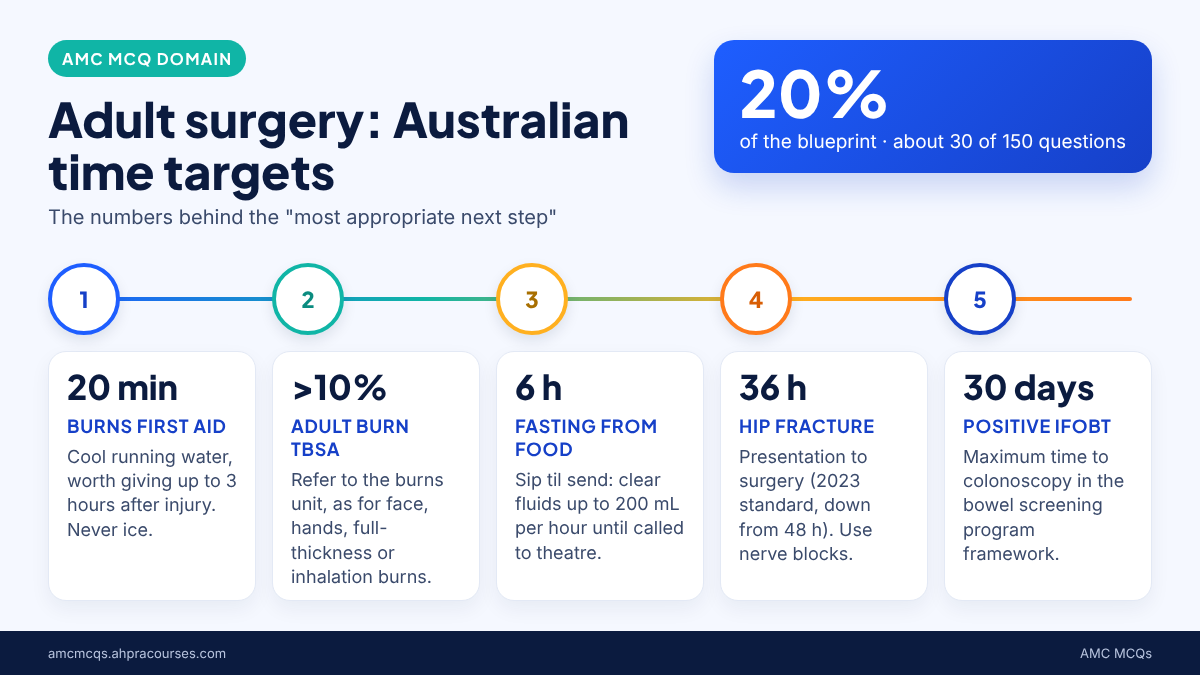
Adult surgery is 20% of the AMC CAT MCQ blueprint, which is about 30 of 150 questions. Learn to recognise surgical emergencies, sequence resuscitation and investigation, and apply Australian time targets and referral criteria.
Adult health – Surgery is the second-largest domain in the AMC CAT MCQ Examination, at 20% of the blueprint. In a 150-item exam that is about 30 questions, more than any domain except medicine. AMC surgery MCQ items rarely ask how to perform an operation. Instead they test whether you recognise a surgical emergency, order the right first investigation, and know Australian time targets and referral rules.
This hub covers the full breadth of the surgical domain, with the Australian standards most likely to decide a close question.
Key takeaways
- Surgery is 20% of the blueprint, which is about 30 of 150 questions.
- Most items test recognition, first investigation and the safest next step, not operative technique.
- Learn the Australian numbers: hip fracture surgery within 36 hours (2023 standard), 20 minutes of cool running water for burns within 3 hours, and colonoscopy within 30 days of a positive iFOBT.
- Resuscitation comes before imaging. If a stem patient is unstable, the answer is almost never "CT first".
- Melanoma margins, burns referral criteria and fasting rules are classic Australian items.
How AMC surgery MCQ questions are examined
Surgical stems follow the same single best answer format as the rest of the exam: a stem, five options and one best response. They map to the three AMC clinician tasks.
- Data gathering: the examination finding or first investigation that changes management. Examples are an erect chest X-ray for suspected perforation, or non-contrast CT KUB for renal colic.
- Interpretation: recognising the pattern behind a cluster of signs. Examples are pain out of proportion to examination in mesenteric ischaemia, or a pulsatile mass with hypotension.
- Management: sequencing. Analgesia, resuscitation, antibiotics, referral or theatre, and in which order.
What a surgical stem usually looks like
Expect an emergency department or ward patient with vital signs, two or three examination findings and one blood result. The distractors are often reasonable actions in the wrong order, such as imaging before resuscitation or discharge before ruling out a time-critical cause. Read the vital signs first. Tachycardia and hypotension change the answer in almost every surgical question.
The acute abdomen
The acute abdomen is the largest single cluster in the surgery domain. The skill tested is matching the clinical picture to the first investigation and the immediate plan.
| Condition | Key clue in the stem | First-line approach |
|---|---|---|
| Acute appendicitis | Periumbilical pain migrating to the right iliac fossa, anorexia, low-grade fever | Clinical diagnosis; ultrasound in young women and children, CT in older adults; surgical referral |
| Acute cholecystitis | Constant right upper quadrant pain, fever, Murphy's sign | Ultrasound; IV antibiotics; early cholecystectomy |
| Ascending cholangitis | Fever, jaundice and right upper quadrant pain | Resuscitation, blood cultures, IV antibiotics, urgent biliary drainage |
| Acute pancreatitis | Epigastric pain radiating to the back, vomiting; gallstones or alcohol | Lipase at least 3 times the upper limit of normal; IV fluids and analgesia; find the cause |
| Small bowel obstruction | Colicky pain, vomiting, distension, previous surgery | Drip and suck (IV fluids, nasogastric tube); CT; surgery if strangulated |
| Perforated viscus | Sudden severe pain, rigid abdomen | Erect chest X-ray or CT; resuscitation; IV antibiotics; surgery |
| Mesenteric ischaemia | Pain out of proportion to signs, AF, raised lactate | CT angiography; urgent vascular or general surgical review |
| Ruptured AAA | Older smoker, back or flank pain, hypotension, pulsatile mass | Straight to theatre if unstable; permissive hypotension |
Exam tip: In any woman of reproductive age with abdominal pain, a pregnancy test comes before imaging and before you settle on a surgical diagnosis. Ruptured ectopic pregnancy is a common hidden answer in "acute abdomen" stems.
Upper and lower GI bleeding
Resuscitate with two large-bore cannulas, group and crossmatch, and correct coagulopathy. Then arrange endoscopy. A patient with a suspected variceal bleed also needs IV antibiotics and a vasoactive drug before endoscopy. In lower GI bleeding with haemodynamic instability, consider an upper source. Brisk bleeding from a duodenal ulcer can present as fresh blood per rectum.
Trauma and emergency surgery
The primary survey
Australian trauma care follows the EMST (Early Management of Severe Trauma) approach of the Royal Australasian College of Surgeons, which is equivalent to ATLS. Stems test whether you follow the sequence: catastrophic haemorrhage, airway with cervical spine protection, breathing, circulation, disability, then exposure.
- Tension pneumothorax: a clinical diagnosis. Decompress immediately; do not wait for a chest X-ray.
- Massive haemothorax or cardiac tamponade: suspect in penetrating chest trauma with shock.
- Haemorrhagic shock: control bleeding, give blood products early and avoid large volumes of crystalloid.
- Head injury: a GCS of 8 or less needs a definitive airway. Use a validated decision rule to decide on CT in minor head injury, and look for anticoagulant use.
Burns
Burns are a reliable Australian topic, because first aid and referral criteria are well defined.
- First aid: cool running water for 20 minutes. It is still worth giving within 3 hours of the injury. Never use ice. Keep the rest of the patient warm.
- Fluid resuscitation in adults: the modified Parkland formula used by Australian burns units gives 3 mL × weight (kg) × %TBSA of Hartmann's in the first 24 hours. Half is given in the first 8 hours from the time of the burn, not from presentation. The Royal Adelaide Hospital protocol starts formula resuscitation above 20% TBSA in adults.
- Urine output target: 0.5–1 mL/kg/hour in adults, higher in high-voltage electrical injury.
- Refer to a burns unit: more than 10% TBSA; burns to the face, hands, feet, genitalia or major joints; full-thickness, electrical, chemical, circumferential or inhalation burns; burns with other trauma; burns in pregnancy or at the extremes of age.
Superficial epidermal burns, which look like sunburn, are not counted in the TBSA estimate. Many candidates lose marks by including them.
Perioperative care
Fasting and "sip til send"
Australian guidance, based on ANZCA, asks adults to fast from food and non-clear fluids for at least 6 hours before anaesthesia. Under the "sip til send" approach adopted in Australian hospitals, adults may keep sipping clear fluids, up to 200 mL per hour, until they are called to theatre. Exceptions that need anaesthetic advice include GLP-1 receptor agonist use, delayed gastric emptying, diabetes and ileus.
Preoperative assessment and medicines
- Anticoagulants and antiplatelets: balance thrombotic and bleeding risk for each patient. Recent coronary stents mean you must not stop dual antiplatelet therapy without cardiology input.
- Diabetes: SGLT2 inhibitors carry a risk of euglycaemic DKA around surgery and are usually withheld beforehand, as directed by local protocols.
- VTE prophylaxis: assess every surgical admission. Combine mechanical and pharmacological prophylaxis according to risk.
Postoperative complications
Timing is the clue. Early fever after surgery is often atelectasis or a physiological response. Fever from day 3 to 5 suggests pneumonia, urinary infection or a line infection. Fever around day 5 to 7 suggests a wound infection or an anastomotic leak. VTE can occur at any time. Postoperative confusion in an older patient is delirium until proven otherwise, so look for hypoxia, sepsis, urinary retention, electrolyte disturbance and medicines.
Surgical oncology and screening
Colorectal cancer
The National Bowel Cancer Screening Program sends an iFOBT every 2 years to people aged 45–74. A positive result needs colonoscopy. The program's performance framework recommends a maximum of 30 days from positive result to colonoscopy. Red flags such as rectal bleeding with change in bowel habit, iron deficiency anaemia or a mass need diagnostic colonoscopy, not screening.
Breast lumps
Assess every breast lump with the triple test: clinical examination, imaging (mammography with or without ultrasound; ultrasound alone in younger women) and non-surgical biopsy. If any of the three is suspicious or indeterminate, the triple test is not reassuring and the lump needs further assessment. A normal mammogram alone never excludes cancer in a woman with a lump.
Melanoma and skin cancer
Australia has one of the world's highest melanoma rates, so expect at least one skin item. For a suspicious pigmented lesion, the preferred diagnostic step is excision biopsy of the whole lesion with a 2–5 mm margin. Partial biopsies, such as shave or punch samples, are less reliable. Definitive wide excision margins then depend on Breslow thickness:
| Breslow thickness | Recommended clinical margin |
|---|---|
| In situ | 5–10 mm |
| ≤1.0 mm (pT1) | 1 cm |
| 1.01–2.0 mm (pT2) | 1–2 cm |
| 2.01–4.0 mm (pT3) | 1–2 cm (2 cm may be preferred) |
| >4.0 mm (pT4) | 2 cm |
Discuss sentinel lymph node biopsy for melanomas 1 mm or thicker, or 0.8 mm or thicker with high-risk features. Lymphatic mapping must come before wide excision. BCC is usually managed by excision, while SCC on the lip or ear and lesions in immunosuppressed patients carry a higher risk.
Neck lumps and thyroid nodules
A persistent neck lump in an adult, especially a smoker, needs assessment for head and neck cancer. Thyroid nodules are assessed with TSH and ultrasound, and fine-needle aspiration is guided by ultrasound features.
Orthopaedics
Hip fracture
The 2023 Hip Fracture Clinical Care Standard from the Australian Commission on Safety and Quality in Health Care cut the time-to-surgery target from 48 hours to 36 hours. It also emphasises:
- early analgesia, including nerve blocks, to reduce opioid use
- delirium, nutrition and frailty assessment
- mobilisation soon after surgery
- secondary fracture prevention
Candidates who learned the older 48-hour figure often choose the wrong option.
Other orthopaedic emergencies and rules
- Compartment syndrome: pain out of proportion, worse on passive stretch. Remove the cast or dressings and arrange urgent fasciotomy. Pulses are often still present.
- Septic arthritis: aspirate the joint before antibiotics, if this does not delay treatment. Then wash out.
- Cauda equina syndrome: back pain with saddle anaesthesia, retention or overflow, so arrange urgent MRI and neurosurgical referral.
- Scaphoid fracture: anatomical snuffbox tenderness with a normal X-ray still needs immobilisation and further imaging.
- Ankle injury: Ottawa ankle rules decide who needs an X-ray.
- Open fractures: IV antibiotics, tetanus cover, a sterile dressing and orthopaedic referral.
Vascular surgery and urology
Vascular
- Acute limb ischaemia: the 6 Ps (pain, pallor, pulselessness, paraesthesia, paralysis, perishing cold). Give heparin and arrange urgent vascular review. Paralysis and sensory loss mean the limb is threatened.
- Chronic peripheral arterial disease: an ankle–brachial index below 0.9 supports the diagnosis. Start with supervised exercise, smoking cessation, antiplatelet therapy and a statin.
- Carotid disease: a symptomatic significant stenosis after a TIA or minor stroke needs urgent vascular assessment.
Urology
- Renal colic: confirm with non-contrast CT KUB. Small distal stones often pass with analgesia. Fever with an obstructed kidney is a urological emergency that needs decompression.
- Testicular torsion: sudden severe pain in an adolescent or young man calls for immediate surgical exploration. Do not delay for ultrasound if the clinical picture is clear.
- Acute urinary retention: catheterise, then look for the cause (prostatic enlargement, constipation, anticholinergic drugs).
- Visible haematuria: in an adult this needs urological assessment for malignancy, especially in smokers.
Common traps for IMGs in AMC surgery MCQs
- Imaging an unstable patient: resuscitation and senior surgical input come first.
- Old time targets: 36 hours, not 48, for hip fracture surgery in Australia.
- Burns first aid: 20 minutes of cool running water within 3 hours, never ice, and keep the patient warm.
- Skipping the pregnancy test: any woman of reproductive age with abdominal pain or before theatre.
- Wrong biopsy for melanoma: excision biopsy with a narrow margin, not a wide excision up front.
- Delaying a torsion operation for ultrasound: time to theatre saves the testis.
How to study adult surgery in our AMC MCQ question bank
Surgical questions reward pattern recognition and sequencing, so revise in clinical clusters rather than by organ system alone.
- Start with a timed block: 30 surgery questions at 84 seconds each in the question bank, matching the real share of the exam.
- Drill by presentation: run tutor-mode sets on acute abdomen, trauma and burns, perioperative care, and surgical oncology.
- Write sequencing rules: in your error log, record the order you got wrong, for example "pregnancy test before CT in RIF pain".
- Link to medicine: GI bleeding, VTE and perioperative diabetes overlap with the adult medicine hub. Gynaecological causes of acute pelvic pain sit on the women's health hub.
- Test under exam conditions: include surgery in mixed blocks, then the full 150-question mock with forward-only navigation.
If you are still deciding how to split your weeks, the AMC MCQ study plan sets out domain-weighted schedules. For exam-day pacing, see how to pass the AMC MCQ on your first attempt.
Worked practice questions
A 79-year-old woman is brought to the emergency department after a fall at home. Her right leg is shortened and externally rotated. X-ray shows a displaced intracapsular fracture of the right femoral neck. She is haemodynamically stable, and her electrolytes and ECG are normal. Which of the following is the most appropriate management plan?
- Analgesia including a nerve block, then surgery within 36 hours
- Bed rest with skin traction for six weeks before mobilising her
- Analgesia, then surgery on the next elective list in seven days
- Oral opioids alone, MRI of the hip, then surgery within 72 hours
- Analgesia, discharge home and outpatient orthopaedic follow-up
Show answer and explanation
Answer: A. The 2023 Australian Hip Fracture Clinical Care Standard recommends early analgesia, including nerve blocks, and surgery within 36 hours of presentation. B describes conservative management, which leads to complications in older patients and is not appropriate for a displaced fracture in a stable patient. C delays surgery well beyond the target. D is wrong because the X-ray has already confirmed the fracture, opioids alone ignore nerve blocks, and 72 hours exceeds the standard. E is unsafe for a patient with a displaced femoral neck fracture.
A 34-year-old man presents 40 minutes after spilling boiling water over his chest, abdomen and right arm. His colleagues have already cooled the area under running water for 20 minutes. He weighs 80 kg. He has partial-thickness burns estimated at 14% total body surface area, sparing his face and hands. His vital signs are normal. Which of the following is the most appropriate next step?
- Apply ice packs for a further 20 minutes, then dress
- Deroof all blisters and apply a topical silver cream
- Dress the wounds and arrange GP review in 48 hours
- Discuss with and refer to the state burns service
- Start oral flucloxacillin to prevent wound infection
Show answer and explanation
Answer: D. Adult burns greater than 10% TBSA meet Australian burns unit referral criteria, so this patient needs discussion with and referral to the burns service. First aid has already been adequate. A is harmful, because ice causes further tissue injury and hypothermia. B is not the immediate priority, and wound care should follow burns unit advice. C is unsafe for a burn of this size. E is wrong because prophylactic antibiotics are not routinely recommended for acute burns.
AMC surgery MCQ: frequently asked questions
How many surgery questions are in the AMC MCQ?
Adult health – Surgery is 20% of the blueprint, so about 30 of the 150 questions are surgical. Some items in every exam are unscored pilot questions, and you cannot identify them, so answer every question carefully.
Do I need to know operative techniques for the AMC surgery MCQ?
Rarely. Questions focus on diagnosis, first investigation, resuscitation, referral and the timing of surgery, at the level expected of a doctor entering supervised practice in Australia.
Which surgical topics are most often tested?
The acute abdomen, trauma and burns, perioperative care, surgical oncology such as bowel, breast and melanoma, orthopaedic emergencies, and vascular and urological emergencies. Australian time targets and referral criteria often decide the answer.
Are AMC surgery MCQs based on Australian guidelines?
Yes. The exam assesses practice in the Australian health system. Use Australian standards such as the Hip Fracture Clinical Care Standard, Cancer Council melanoma guidance and Australian burns unit protocols when an option depends on a threshold or time target.
How should I balance surgery against other domains?
Give surgery about a fifth of your question practice, in line with its 20% weight. Revise overlapping topics, such as GI bleeding, VTE and pelvic pain, alongside medicine and women's health so the knowledge transfers across domains.
Free sample Surgery questions from our bank
Three questions from the bank, shown with answers. Sign up free for ten more in this domain, in tutor mode.
Sample 1: Appendicitis
A 22-year-old man presents to the emergency department with 18 hours of abdominal pain that began around the umbilicus and has moved to the right iliac fossa. He has anorexia and has vomited once. Temperature is 37.9 °C and pulse 98/min. There is localised tenderness and guarding at McBurney's point. White cell count is 14.2 × 10^9/L with a neutrophilia and CRP is 48 mg/L. Urinalysis is normal. What is the most appropriate management?
Answer: A. Migratory periumbilical-to-RIF pain, anorexia, low-grade fever, localised peritonism and neutrophilia give a high clinical probability of acute appendicitis. In a young man with this picture, imaging is not mandatory and the standard of care is IV antibiotics with laparoscopic appendicectomy. Laparoscopy offers less wound infection, less pain and faster recovery than open surgery.
Learning point: A young man with classic clinical features of appendicitis should proceed to laparoscopic appendicectomy without needing routine imaging.
Sample 2: Choledocholithiasis and cholangitis
A 74-year-old woman is admitted with acute cholangitis due to a common bile duct stone seen on ultrasound. Despite 12 hours of IV amoxicillin and gentamicin and 2 L of crystalloid, she remains febrile at 38.9 °C with pulse 118/min and BP 92/58 mmHg, and she has become newly confused. Bilirubin has risen from 70 to 110 µmol/L. INR is 1.2 and platelets 160 × 10^9/L. What is the most appropriate next step?
Answer: E. She has severe (Tokyo grade III) cholangitis with hypotension and confusion that is failing medical therapy. Definitive treatment is urgent biliary decompression, and ERCP with sphincterotomy, stone extraction or stent placement is first-line. Percutaneous transhepatic drainage is the alternative if ERCP fails or is not possible. Her coagulation is acceptable for the procedure.
Learning point: Cholangitis that fails to respond to resuscitation and antibiotics requires urgent biliary drainage, usually by ERCP.
Sample 3: Colorectal cancer
A 66-year-old woman undergoes colonoscopy for rectal bleeding. An ulcerating tumour is found 7 cm from the anal verge and biopsy confirms adenocarcinoma. CT of the chest, abdomen and pelvis shows no distant metastases. Her CEA is mildly elevated. She is fit and keen for curative treatment. The colorectal multidisciplinary team requests further local staging before deciding on neoadjuvant therapy. Which investigation is most appropriate?
Answer: C. High-resolution pelvic MRI is the standard for local staging of rectal cancer. It defines tumour depth, mesorectal fascia (circumferential resection margin) involvement, extramural venous invasion and nodal disease, which determine whether neoadjuvant chemoradiotherapy is needed. Endorectal ultrasound is an adjunct mainly for early tumours.
Learning point: Rectal cancer is locally staged with pelvic MRI, which guides the need for neoadjuvant therapy.
Subtopics in our Surgery question bank
Number of questions per subtopic. Your dashboard tracks your accuracy in each one.
- Abdominal & pelvic trauma 10
- Abdominal imaging choice 10
- Achalasia 10
- Anaesthesia basics & local anaesthetic toxicity 10
- Anorectal disorders 10
- Appendicitis 10
- Bariatric surgery basics 10
- Bowel obstruction 10
- Breast cancer management 10
- Breast lumps and triple assessment 10
- Burns 10
- Chest trauma 10
- Cholecystitis and biliary colic 10
- Choledocholithiasis and cholangitis 10
- Colorectal cancer 10
- Diverticulitis 10
- Dysphagia work-up 10
- Head injury 10
- Hernias 10
- Mesenteric ischaemia 10
- Oesophageal and gastric cancer 10
- Pain management & opioid safety 10
- Parathyroid surgery 10
- Perforated viscus 10
- Postoperative complications 10
- Postoperative fluids & electrolytes 10
- Preoperative assessment & anticoagulant management 10
- Primary survey (EMST/ATLS) 10
- Surgical sepsis 10
- Thyroid nodules and thyroid surgery complications 10
- Abdominal aortic aneurysm 8
- Peripheral arterial disease and acute limb ischaemia 8
- Ankle fractures and Ottawa rules 7
- Back pain red flags and cauda equina 7
- Bladder and kidney cancer 7
- BPH and urinary retention 7
- Carotid disease 7
- Diabetic foot 7
- Dislocations 7
- DVT surgical aspects 7
Unlock the full Surgery bank
Every pack includes this domain in its blueprint share, plus timed blocks and the full mock exam.
500 questions
About A$10 per 100 questions
- Every domain in AMC blueprint proportions
- Full explanation for every option
- Tutor and timed modes
- Full 150-question mock exam
1,000 questions
About A$10 per 100 questions
- Everything in the 500 pack
- Twice the practice for a full study cycle
- Weak-area drills and redo-incorrect
- Bookmarks and full history
3,000 questions
About A$10 per 100 questions
- The complete 3,000-question bank
- Includes every question in the 500 and 1,000 packs
- Best value per question
- Mock exam drawn from all 3,000 questions
One payment, no subscription. Higher packs include every question from the smaller packs.