AMC Child Health MCQs: Paediatrics Revision for IMGs
Child health is 12.5% of the AMC CAT MCQ, about 19 of 150 questions, and most stems follow Australian guidance such as the RCH clinical practice guidelines and the National Immunisation Program. This hub covers the doses, age cut-offs and decisions that decide those marks, with worked questions and free practice.
Child health makes up 12.5% of the AMC CAT MCQ blueprint, so expect about 19 of your 150 questions to involve a newborn, child or adolescent. This AMC paediatrics MCQ hub covers what those questions test, the Australian guidelines they are written from, and the numbers you need to recall under time pressure: weight-based doses, age cut-offs, oxygen targets and the National Immunisation Program (NIP) schedule.
Much of paediatrics will feel familiar wherever you trained. The marks are lost on Australian details, such as steroids in croup, salbutamol in bronchiolitis, bag urine and vaccine timing.
Key takeaways
- Child health is 12.5% of the blueprint: about 19 questions in a 150-item exam.
- Most stems are written from Royal Children's Hospital (RCH) Melbourne practice, the Australian Immunisation Handbook and eTG, so learn those doses and thresholds.
- High-yield areas: febrile infants, respiratory distress (croup, bronchiolitis, asthma, anaphylaxis), dehydration and fluids, the NIP schedule, development, and child protection.
- Typical traps: salbutamol or steroids in bronchiolitis, bag urine for culture, delaying antibiotics in suspected meningococcal disease, and codeine in children under 12.
- Practise in timed blocks of 84 seconds a question and keep an error log of every dose or age cut-off you get wrong.
How child health is examined in the AMC paediatrics MCQ
The AMC blueprint is organised by patient group, so a question is child health when the patient is a neonate, child or adolescent. Each item has a stem, five options and one best answer, sometimes with a growth chart, blood gas, X-ray or rash photograph. All three clinician tasks appear:
- Data gathering: the finding that matters most, such as a milestone history or a check for a non-blanching rash.
- Data interpretation: the most likely diagnosis, for example a 6-week-old with projectile vomiting and a metabolic alkalosis.
- Management: the next step, drug, dose or disposition (discharge, observe, admit, transfer).
Management stems usually hinge on one detail: age, weight, a vital sign or symptom duration. Note all four before you read the options.
Newborns and the first weeks of life
Jaundice, vomiting and the surgical newborn
- Jaundice in the first 24 hours is pathological (haemolysis, sepsis) until proven otherwise.
- Prolonged jaundice (beyond about 14 days in a term baby) needs a conjugated bilirubin: pale stools and dark urine suggest biliary atresia.
- Bilious vomiting in a neonate is malrotation with volvulus until proven otherwise. It needs urgent surgical review and a contrast study.
- Pyloric stenosis (2–8 weeks): non-bilious projectile vomiting, hypochloraemic hypokalaemic metabolic alkalosis, ultrasound diagnosis. Correct fluids and electrolytes before pyloromyotomy.
Routine newborn care in Australia
Hepatitis B vaccine is given within 7 days of birth, ideally within 24 hours. Newborns have bloodspot and hearing screening and a hip examination (Barlow and Ortolani). Breech presentation or a family history of DDH calls for a hip ultrasound even if the examination is normal. Safe-sleeping advice to reduce SUDI: on the back, face uncovered, smoke-free, in a safe cot.
Fever and serious bacterial infection
The febrile infant: age decides the work-up
The RCH defines fever as 38.0°C or higher. In young infants, age matters more than how well the baby looks:
| Corrected age | RCH approach |
|---|---|
| ≤21 days | Full septic work-up (FBE, CRP, blood culture, urine culture with SPA preferred, lumbar puncture). Start empiric IV antibiotics promptly however well the baby looks; add aciclovir if unwell or investigations are delayed. |
| 22–28 days | Slightly lower risk. If well with low-risk inflammatory markers, LP and antibiotics may be deferred, but the infant is still admitted. |
| 1–3 months | Lower threshold for investigation and treatment than in older children. A well infant with normal results and senior review may go home with review in 24–48 hours. |
Urinary tract infection
- SPA is the gold standard up to 6 months; clean catch suits well pre-continent children. Bag specimens are not acceptable for culture.
- Oral cefalexin for cystitis: 20 mg/kg (max 750 mg) three times daily for 3–5 days.
- Infants under 3 months and seriously unwell children need admission for IV antibiotics. Gentamicin is the empiric choice.
- Renal ultrasound for atypical or recurrent UTI; most first UTIs need no imaging.
Kawasaki disease and meningococcal disease
Kawasaki disease: fever for at least 4 days plus at least 4 of 5 features (conjunctival injection, polymorphous rash, extremity changes, unilateral cervical lymphadenopathy, mucosal changes). Give IVIG 2 g/kg as a single infusion and aspirin 5 mg/kg once daily until cardiology review at about 6 weeks. Echo at baseline and at 4–6 weeks. Delay live vaccines for 11 months after IVIG.
Suspected meningococcal disease (fever with a non-blanching rash): give parenteral antibiotics immediately, without waiting for a lumbar puncture or transfer, and notify public health.
Respiratory distress, wheeze and anaphylaxis
Breathing problems are the most tested emergencies in AMC paediatrics MCQs. Know this table cold:
| Condition | Typical patient | Key management (Australian practice) | Do not |
|---|---|---|---|
| Croup | 6 months–6 years, barking cough, inspiratory stridor | Oral dexamethasone 0.15 mg/kg (or prednisolone 1 mg/kg) for mild with stridor or moderate croup; severe: dexamethasone 0.6 mg/kg (max 12 mg) plus nebulised adrenaline | Agitate the child or examine the throat; discharge less than 3 hours after adrenaline |
| Bronchiolitis | Under 12 months, coryza then cough, crackles and wheeze | Supportive care. Oxygen only if SpO2 is persistently below 90%; NG fluids preferred, at two-thirds maintenance | Salbutamol, steroids, antibiotics, adrenaline, routine chest X-ray |
| Acute asthma | Usually over 1 year, wheeze, known triggers | Salbutamol 100 microgram/puff via spacer: 6 puffs under 6 years, 12 puffs 6 years and over, every 20 minutes for three doses in moderate–severe; add ipratropium; oral prednisolone | Under-dose, or use a nebuliser when a spacer would work |
| Anaphylaxis | Any age, allergen exposure, airway, breathing or circulation compromise | IM adrenaline 0.01 mg/kg of 1:1000 (max 0.5 mg) into the outer mid-thigh, repeated every 5 minutes if needed; lie flat | Stand or walk the child; rely on antihistamines |
Numbers to know
- Croup: observe for at least 3 hours after nebulised adrenaline. Stridor loudness is a poor guide to severity. Under 6 months, consider another diagnosis.
- Bronchiolitis: high-flow only if SpO2 stays below 90% after about 2 hours of low-flow oxygen. Severe-disease risk factors include age under 10 weeks, prematurity, heart or lung disease, Aboriginal or Torres Strait Islander background and trisomy 21.
- Asthma: oral prednisolone 2 mg/kg (max 50 mg) on day 1, then 1 mg/kg on days 2 and 3 (Children's Health Queensland). IV magnesium 50 mg/kg for severe, unresponsive asthma. A silent chest is life-threatening.
- Anaphylaxis devices (ASCIA): 150 microgram for 7.5–20 kg, 300 microgram over 20 kg, and 300 or 500 microgram over 50 kg. Observe for at least 4 hours after the last adrenaline dose.
Gastroenteritis, dehydration and fluids
- Route: oral rehydration solution at about 10 mL/kg/hour; NG if oral fails; IV only if NG is not tolerated.
- Ondansetron (over 6 months, persistent vomiting): 2 mg for 8–15 kg, 4 mg for 15–30 kg, 8 mg over 30 kg.
- Avoid anti-diarrhoeals, anti-spasmodics, routine antibiotics and hypertonic fluids such as sports drinks.
- Maintenance (RCH, hourly): 4 mL/kg for the first 10 kg, 2 mL/kg for the next 10 kg, then 1 mL/kg for each kg above 20 kg, up to 100 mL/hour. Use 0.9% sodium chloride with 5% glucose (with or without potassium). Most unwell children get two-thirds of full maintenance.
Exam tip: For a 15 kg child, full maintenance is 40 + (2 × 5) = 50 mL/hour, and two-thirds is about 33 mL/hour. Options often include the full rate, the two-thirds rate and the daily volume, so check what is asked.
Intussusception usually affects children aged about 3 months to 3 years. It causes episodes of colicky pain with pallor and drawing up of the legs; vomiting and "redcurrant jelly" stool come late. Ultrasound confirms it. Air enema reduction is first-line unless there is peritonitis or perforation.
Immunisation: the NIP schedule for children
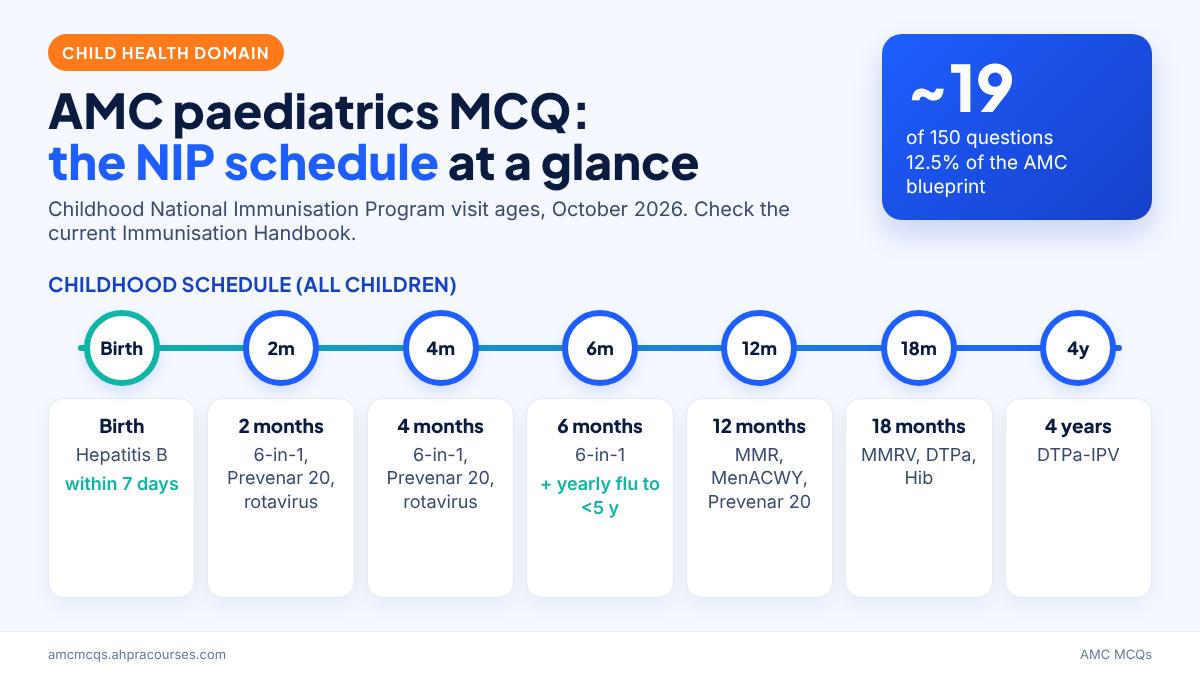
Vaccine timing is easy to examine and easy to confuse with another country's schedule. This is the childhood NIP at the time of writing (October 2026); confirm it against the current Australian Immunisation Handbook.
| Age | Vaccines (all children) | Extra for Aboriginal and Torres Strait Islander children |
|---|---|---|
| Pregnancy | Pertussis (dTpa) at 20–32 weeks each pregnancy; influenza in any trimester; RSV (Abrysvo) from 28 weeks | — |
| Birth | Hepatitis B, within 7 days (ideally 24 hours) | — |
| 2 months (from 6 weeks) | DTPa-hepB-IPV-Hib; pneumococcal (Prevenar 20); rotavirus (oral, dose 1 at 6–14 weeks) | Meningococcal B (with prophylactic paracetamol) |
| 4 months | DTPa-hepB-IPV-Hib; Prevenar 20; rotavirus (dose 2 at 10–24 weeks) | Meningococcal B |
| 6 months | DTPa-hepB-IPV-Hib; annual influenza from 6 months to under 5 years | Extra Prevenar 20 dose (also for medically at-risk infants) |
| 12 months | MMR; meningococcal ACWY; Prevenar 20 | Meningococcal B |
| 18 months | MMRV; DTPa; Hib | — |
| 4 years | DTPa-IPV | — |
| Year 7 / Year 10 | Year 7: HPV (single dose) and dTpa. Year 10: meningococcal ACWY | Annual influenza continues |
Infants can also receive nirsevimab (an RSV monoclonal antibody) through state programs in RSV season. Rotavirus age limits are strict: if dose 1 is not given by 14 weeks, the course is not started.
Growth, development and behaviour
Developmental stems ask whether a child is normal, needs review or needs urgent referral. Red flags that call for action:
- Loss of previously gained skills at any age.
- Not walking, or no meaningful words, by 18 months.
- Hand preference before about 12 months (suggests weakness on the other side).
- Parental concern about hearing or vision. Exclude hearing loss in any speech delay.
- Weight crossing two major centile lines: think intake, malabsorption (coeliac disease, cystic fibrosis), chronic illness and neglect.
Autism and ADHD are tested on recognition and referral, not prescribing. Simple febrile seizures (6 months to 5 years, generalised, under 15 minutes) need the fever source found and reassurance; regular antipyretics do not prevent recurrence.
Child protection and adolescent health
Doctors are mandatory reporters of child abuse in every Australian state and territory (in NSW, those who deliver health care to children). The threshold and the types of abuse covered differ by jurisdiction. In an exam answer, the doctor reports to the state child protection service and does not investigate or wait for proof. Concerning features: bruising in a non-mobile baby, an injury that does not fit the history or developmental stage, delay in seeking care, and rib, metaphyseal or multiple fractures of different ages.
For adolescents, take a HEADSS history (Home, Education, Activities, Drugs, Sexuality, Suicide/mood) and see the young person alone for part of the consultation. Confidentiality and mature-minor consent are covered on the population health and ethics MCQ page. Self-harm and eating disorders overlap with the AMC mental health MCQ hub.
Common traps for IMGs in AMC paediatrics MCQs
- Treating bronchiolitis like asthma. Salbutamol, steroids and antibiotics are wrong, even with eczema.
- Forgetting steroids in croup. Moderate croup gets oral dexamethasone.
- Accepting a bag urine for culture. The next step is a clean catch, SPA or catheter specimen.
- Delaying antibiotics in suspected meningococcal disease to do an LP or arrange a CT.
- Codeine in children. The TGA contraindicates it under 12 years.
- Aspirin. Avoid (Reye syndrome) except in Kawasaki disease.
- Missing the extra vaccines recommended for Aboriginal and Torres Strait Islander children (meningococcal B, an extra pneumococcal dose, annual influenza).
- Exceeding the maximum dose. A 60 kg 14-year-old gets the adult maximum, not mg/kg × 60.
How to study child health in our question bank
Our 3,000 original questions are weighted to the blueprint, so about one in eight is child health, each with an explanation for every option. A sequence that works:
- Tutor mode, one subtopic at a time (respiratory, fever, fluids, immunisation, development, protection).
- A one-line dose card for every drug you miss: mg/kg, maximum, route, frequency.
- Timed mixed blocks at 84 seconds a question, to practise switching between paediatric and adult dosing.
- Domain analytics and weak-area drills, redoing missed questions until you get them right twice.
- The full 150-question mock to check your paediatrics holds up late in the exam.
You can try 10 child health questions free with an account at the AMC MCQ practice bank, and compare packs on the pricing page. See also AMC MCQ high-yield topics and Australian guidelines for the AMC MCQ.
Worked AMC child health practice questions
A 2-year-old boy weighing 12 kg is brought to a regional emergency department at 9 pm with a 1-day history of coryza and a barking cough. He has intermittent inspiratory stridor at rest, mild subcostal recession, a respiratory rate of 32/min and SpO2 of 97% on room air. He is alert and interactive. Which is the most appropriate initial management?
- Nebulised salbutamol 2.5 mg and review in one hour
- Oral dexamethasone 1.8 mg and observe in the department
- Nebulised adrenaline 5 mL of 1:1000 and admit to the ward
- Oral amoxicillin 25 mg/kg and discharge with advice
- Throat examination with a tongue depressor to exclude epiglottitis
Show answer and explanation
Answer: B. This is moderate croup: stridor and recession, but an alert child with normal saturations. RCH guidance is oral dexamethasone 0.15 mg/kg (0.15 × 12 kg = 1.8 mg) or prednisolone 1 mg/kg, then observation (longer overnight). Salbutamol (A) treats bronchospasm, not upper airway oedema. Nebulised adrenaline (C) is for severe croup or a child who is deteriorating, and 5 mL of 1:1000 is the life-threatening-croup dose. Croup is viral, so antibiotics (D) have no place. Examining the throat (E) can cause complete obstruction in true epiglottitis, and nothing here (a toxic child, drooling, no cough) suggests it.
An 18-day-old girl born at term is brought in because her mother measured a temperature of 38.3°C. She is feeding well, has a normal cry and tone, and there is no focus of infection on examination. Her temperature in the department is 38.2°C. Urine dipstick is negative. Which is the most appropriate next step?
- Discharge home with paracetamol and review in 24 hours
- Collect a bag urine specimen and await the culture result
- Observe for 4 hours and repeat the temperature before deciding
- Full septic work-up including LP, then empiric IV antibiotics
- Blood culture, then oral cefalexin pending the result
Show answer and explanation
Answer: D. Under RCH guidance, any infant aged 21 days or younger (corrected) with a temperature of 38.0°C or higher needs a full septic work-up: FBE, CRP, blood culture, urine culture (suprapubic aspirate preferred), lumbar puncture, and a chest X-ray if indicated. Empiric IV antibiotics should start promptly regardless of how well she looks. Neonates can have serious bacterial infection with few signs, so discharge (A) and a period of observation (C) are both unsafe. Bag urine (B) is not acceptable for culture, and a negative dipstick does not rule out UTI at this age. Oral antibiotics (E) are inadequate for a febrile neonate and would partly treat any meningitis before an LP.
AMC paediatrics MCQ: frequently asked questions
How many child health questions are in the AMC CAT MCQ?
Child health is 12.5% of the AMC blueprint, which works out at about 19 questions in the 150-question exam. Some items you see are unscored new questions, so the exact number that counts towards your result varies.
Which Australian guidelines should I use for AMC paediatrics revision?
Use the Royal Children's Hospital Melbourne clinical practice guidelines for acute paediatrics, the Australian Immunisation Handbook and NIP schedule for vaccines, ASCIA for anaphylaxis, and Therapeutic Guidelines (eTG) for antimicrobials. These match how Australian stems are written.
Do I need to memorise paediatric drug doses for the AMC MCQ?
Learn the doses that turn up repeatedly: dexamethasone for croup, adrenaline for anaphylaxis, salbutamol puffs by age, prednisolone for asthma, ondansetron bands and maintenance fluid rates. Calculating a dose from a weight given in the stem is a common question type.
Are newborn questions counted as child health or women's health?
The AMC blueprint groups questions by patient. As a rule of thumb, if the baby is the patient (neonatal jaundice, a febrile neonate, DDH), treat it as child health. Pregnancy, labour and maternal postnatal care fall under women's health.
Is the Australian immunisation schedule tested in the AMC MCQ?
Yes. Expect questions on visit ages, rotavirus age limits, the vaccines given at 12 and 18 months, catch-up and post-exposure decisions, and the extra vaccines recommended for Aboriginal and Torres Strait Islander children. Check the current schedule because it changes.
What is the best way to improve a weak child health score?
Work through tutor-mode questions by subtopic, keep a dose and age cut-off error log, redo the questions you got wrong until you answer them correctly twice, and then test yourself in timed mixed blocks at 84 seconds a question.
Free sample Paediatrics questions from our bank
Three questions from the bank, shown with answers. Sign up free for ten more in this domain, in tutor mode.
Sample 1: Newborn examination
A 2-day-old boy is examined before discharge from a regional maternity unit. He was born at 39 weeks by spontaneous vaginal delivery after an uncomplicated pregnancy and is feeding well. On ophthalmoscopy in a darkened room, a normal red reflex is seen in the right eye, but the left pupil appears white. The rest of the examination is normal. His father had an eye removed in early childhood because of a tumour. What is the most appropriate next step in management?
Answer: A. An absent or white red reflex (leukocoria) in a newborn requires urgent ophthalmology review because the main causes, congenital cataract and retinoblastoma, are sight- and life-threatening and time-critical. The paternal history strongly suggests heritable (RB1) retinoblastoma. Delaying assessment to the 6-week check risks amblyopia from cataract or tumour progression.
Learning point: An abnormal or absent red reflex at the newborn check needs urgent paediatric ophthalmology referral to exclude cataract and retinoblastoma.
Sample 2: Neonatal resuscitation
A baby is born at 39 weeks by emergency caesarean section for fetal bradycardia. She is floppy and not breathing. She has been dried, stimulated and placed under a radiant warmer with her head in the neutral position, and the airway has been cleared of a small amount of secretions. At 40 seconds of age she remains apnoeic and her heart rate on auscultation is 80/min. What is the most appropriate next step?
Answer: E. According to ANZCOR neonatal guidelines, a baby who is apnoeic, gasping or has a heart rate below 100/min after initial steps should receive positive-pressure ventilation within the first minute. For term and late preterm babies, ventilation is started with air (21% oxygen) and titrated to pulse oximetry. Effective ventilation is the single most important intervention in newborn resuscitation.
Learning point: Start PPV within the first minute if a newborn is apnoeic or the heart rate is below 100/min, using air for term babies.
Sample 3: Neonatal jaundice
A midwife on the postnatal ward asks you to review an 18-hour-old term baby boy because he looks yellow. Jaundice is visible on the face and chest. He is feeding well, alert and has normal observations. His mother is blood group O Rh-positive and this is her second baby. What is the most appropriate next step?
Answer: D. Jaundice appearing within the first 24 hours of life is always considered pathological until proven otherwise, most often due to haemolysis such as ABO or rhesus isoimmunisation. Total serum bilirubin should be measured urgently and plotted on a gestation-specific chart, together with blood group, direct antiglobulin test and haemoglobin. Visual estimation is unreliable.
Learning point: Jaundice in the first 24 hours is pathological and needs an urgent serum bilirubin measurement.
Subtopics in our Paediatrics question bank
Number of questions per subtopic. Your dashboard tracks your accuracy in each one.
- ADHD 7
- Birth injuries 7
- Child protection & mandatory reporting 7
- Congenital infections 7
- Developmental dysplasia of the hip 7
- Developmental milestones & delay 7
- National Immunisation Program schedule & contraindications 7
- Neonatal hypoglycaemia 7
- Neonatal jaundice 7
- Neonatal resuscitation 7
- Neonatal sepsis 7
- Newborn examination 7
- Newborn screening 7
- Respiratory distress in the newborn 7
- Asthma in children 6
- Autism spectrum disorder 6
- Behavioural problems 6
- Bronchiolitis 6
- Croup 6
- Enuresis & encopresis 6
- Failure to thrive 6
- Fever in infants and children 6
- Infant formula & cow's milk protein allergy 6
- Infants of diabetic mothers 6
- Meningitis and sepsis 6
- Neonatal abstinence syndrome 6
- Neonatal feeding problems 6
- Nutrition & breastfeeding 6
- Obesity in children 6
- Otitis media 6
- Pneumonia in children 6
- Prematurity complications 6
- Puberty disorders 6
- Short stature 6
- Speech & hearing concerns 6
- Sudden unexpected infant death & safe sleeping 6
- Tonsillitis and scarlet fever 6
- Viral exanthems 6
- Anaphylaxis 5
- Appendicitis in children 5
Unlock the full Paediatrics bank
Every pack includes this domain in its blueprint share, plus timed blocks and the full mock exam.
500 questions
About A$10 per 100 questions
- Every domain in AMC blueprint proportions
- Full explanation for every option
- Tutor and timed modes
- Full 150-question mock exam
1,000 questions
About A$10 per 100 questions
- Everything in the 500 pack
- Twice the practice for a full study cycle
- Weak-area drills and redo-incorrect
- Bookmarks and full history
3,000 questions
About A$10 per 100 questions
- The complete 3,000-question bank
- Includes every question in the 500 and 1,000 packs
- Best value per question
- Mock exam drawn from all 3,000 questions
One payment, no subscription. Higher packs include every question from the smaller packs.