Adult Medicine for the AMC MCQ: Australian Revision Hub
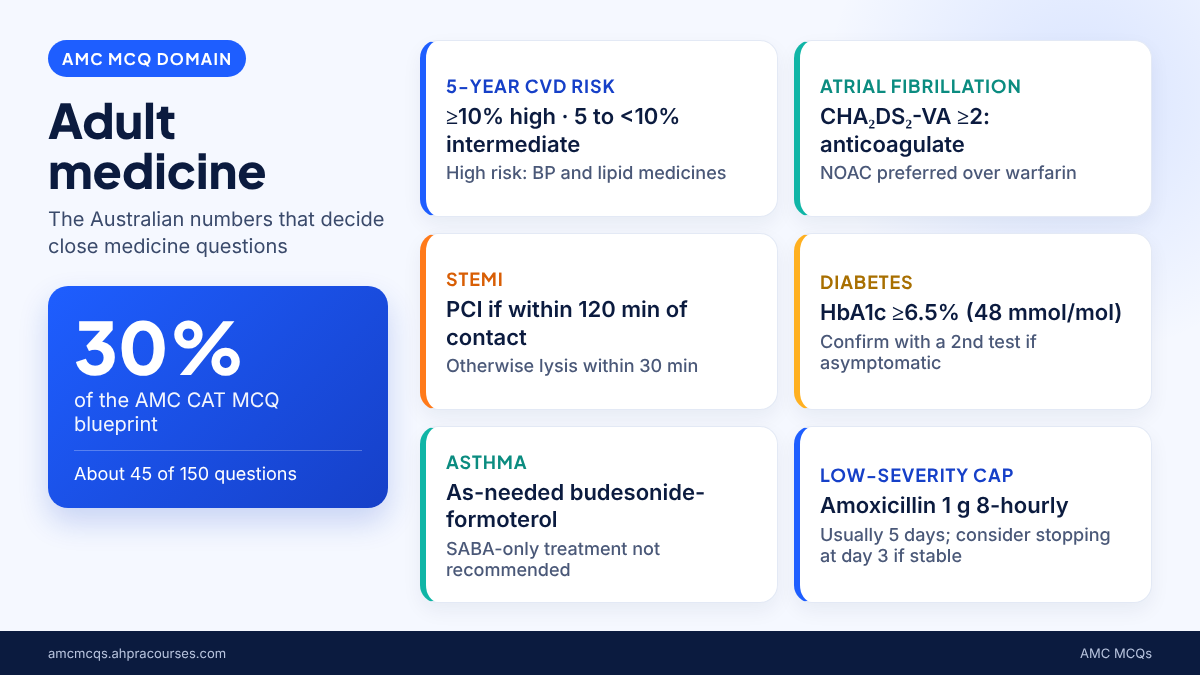
Adult medicine carries 30% of the AMC CAT MCQ blueprint, which is about 45 of your 150 questions. This hub sets out the Australian thresholds, first-line treatments and common IMG traps across every medical subspecialty, with worked practice questions.
Adult health – Medicine is the single largest domain in the AMC CAT MCQ Examination. It carries 30% of the blueprint, so in a 150-item exam you should expect about 45 questions on adult medical patients. This hub gathers what AMC adult medicine MCQs actually test: the Australian thresholds, first-line treatments and decision points that separate a passing answer from a plausible distractor.
Every number below comes from current Australian guidance. Use it to plan your revision, then test yourself in the question bank.
Key takeaways
- Medicine is 30% of the AMC MCQ blueprint, which works out to about 45 of 150 questions.
- Stems test data gathering, data interpretation and management. Management questions usually ask for the "most appropriate next step".
- Know the Australian numbers cold: 5-year CVD risk categories (<5%, 5 to <10%, ≥10%), HbA1c ≥6.5% for diabetes, CHA2DS2-VA ≥2 for anticoagulation, and the 120-minute PCI rule in STEMI.
- Australian first-line choices often differ from what you learned at home. Examples are as-needed budesonide-formoterol in asthma, amoxicillin 1 g 8-hourly for low-severity pneumonia and nitrofurantoin for 5 days for cystitis.
- Practise in timed blocks at 84 seconds per question and track your accuracy by subtopic, not just by domain.
How AMC adult medicine MCQs are examined
The AMC specifications describe content across the disease process, clinical examination and diagnosis, investigation, and therapy and management. Every item is single best answer: a clinical stem, five options, one best response. Image and data items, such as ECGs, blood results, spirometry or chest X-ray descriptions, use the same five-option format.
Questions are also mapped to three clinician tasks. These are not weighted, but you will see all three in adult medicine.
- Data gathering: which history question, examination finding or first investigation adds the most. For example, "What is the most appropriate initial investigation?"
- Data interpretation and synthesis: reading an arterial blood gas, a set of electrolytes or an ECG, then naming the diagnosis or mechanism.
- Management: choosing the best next step, first-line drug or disposition. This is where Australian guidance matters most.
Typical stem patterns in the medicine domain
Most stems describe a general practice or emergency patient with three or four relevant findings and a distractor or two. Many give risk score inputs (age, smoking, BP, lipids) and expect you to place the patient in a treatment category. Others describe a deteriorating inpatient, where airway, breathing and circulation priorities beat a definitive investigation. Because the exam is adaptive, a strong candidate meets harder items with two defensible options, only one of which matches Australian guidance.
Cardiovascular medicine
Absolute CVD risk: the 2023 Australian guideline
Australia manages primary prevention by absolute risk, not by single risk factors. The 2023 guideline uses the Aus CVD Risk Calculator and recommends assessment for:
- all people aged 45–79 without known CVD
- people with diabetes from age 35
- Aboriginal and Torres Strait Islander people from age 30 (individual risk factors from age 18)
| 5-year CVD risk | Category | Medicines |
|---|---|---|
| <5% | Low | Lifestyle advice; medicines not routinely recommended |
| 5% to <10% | Intermediate | Consider BP-lowering and lipid-modifying medicines |
| ≥10% | High | Prescribe BP-lowering and lipid-modifying medicines unless contraindicated |
Some patients are high risk without calculation. These include confirmed familial hypercholesterolaemia and moderate to severe CKD, meaning a sustained eGFR <45 mL/min/1.73m² or a persistent urine albumin-to-creatinine ratio (uACR) above 25 mg/mmol in men or 35 mg/mmol in women. Regardless of category, BP above 160/100 mmHg or total cholesterol above 7.5 mmol/L warrants treatment.
Hypertension
Clinic BP of 140/90 mmHg or above is the diagnostic threshold. The out-of-clinic equivalents are daytime ambulatory or home BP of 135/85 or above, and 24-hour ambulatory BP of 130/80 or above. Offer ambulatory or home monitoring to confirm the diagnosis.
- First-line classes: ACE inhibitor or ARB, calcium channel blocker, or thiazide diuretic.
- Not first-line: beta-blockers for uncomplicated hypertension.
- Never combine: an ACE inhibitor with an ARB.
- Target: <140/90 mmHg, or lower if tolerated. A systolic target below 120 mmHg may suit selected high-risk patients who are closely monitored.
Acute coronary syndromes
For STEMI, the Heart Foundation and CSANZ guideline prefers primary PCI if it can be performed within 120 minutes of first medical contact. If PCI will be delayed by more than 120 minutes and there is no absolute contraindication, give fibrinolysis, ideally within 30 minutes of first medical contact and before hospital arrival. Fibrinolysis is not recommended more than 12 hours after symptom onset.
So a patient three hours from a cath lab should usually be thrombolysed, not transferred for PCI.
Atrial fibrillation
The Australian guideline uses the sex-neutral CHA2DS2-VA score, so female sex adds no points. This is a classic trap for candidates trained on CHA2DS2-VASc.
| CHA2DS2-VA score | Recommendation |
|---|---|
| 0 | Anticoagulation not recommended; review risk yearly |
| 1 | Consider anticoagulation |
| ≥2 | Anticoagulation recommended unless contraindicated |
For non-valvular AF, prefer a NOAC (apixaban, dabigatran or rivaroxaban) over warfarin. Aspirin is not recommended for stroke prevention. For rate control, use a beta-blocker or a non-dihydropyridine calcium channel blocker first. Avoid verapamil and diltiazem in LV systolic dysfunction, and keep amiodarone as the last-line option. Opportunistic AF screening is recommended from age 65.
Respiratory medicine
Asthma
The Australian Asthma Handbook recommends starting adults and adolescents on low-dose budesonide-formoterol taken as needed. The alternative is regular low-dose ICS with as-needed salbutamol. SABA-only treatment is not recommended for anyone with asthma. If a stem offers "salbutamol as required" as the sole treatment for a new adult diagnosis, it is a distractor.
COPD
Confirm COPD with post-bronchodilator spirometry showing an FEV1/FVC ratio below 0.7. For a mild infective exacerbation, Therapeutic Guidelines recommends amoxicillin 500 mg orally 8-hourly for 5 days. Smoking cessation and pulmonary rehabilitation are the outcome-changing answers.
Community-acquired pneumonia
For low-severity pneumonia, the first-line choice is amoxicillin 1 g orally 8-hourly. The usual duration is 5 days, and Therapeutic Guidelines suggests considering stopping at review on day 3 if the patient is clinically stable. A patient who is not stable by day 5 needs review. Severity assessment decides the setting and the regimen. Questions usually hinge on recognising who needs admission (hypotension, hypoxia, confusion, multilobar changes).
Lung cancer screening
Australia's National Lung Cancer Screening Program offers low-dose CT every 2 years to people who meet all of these criteria:
- aged 50–70
- no symptoms suggestive of lung cancer
- currently smoke or quit within the past 10 years
- at least 30 pack-years of cigarette smoking
Symptomatic patients follow the diagnostic pathway instead.
Endocrinology and diabetes
Screening and diagnosing type 2 diabetes
The RACGP recommends AUSDRISK every 3 years from age 40. A score of 12 or more is high risk and should prompt testing with fasting glucose or HbA1c. Aboriginal and Torres Strait Islander adults should be screened with blood tests from age 18, because AUSDRISK has limited use in this group.
| Test | Diagnostic threshold |
|---|---|
| HbA1c | ≥6.5% (48 mmol/mol) |
| Fasting plasma glucose | ≥7.0 mmol/L |
| Random glucose | ≥11.1 mmol/L |
| 75 g OGTT, 2-hour value | ≥11.1 mmol/L |
In an asymptomatic person, one abnormal result is not enough. Confirm with a second abnormal test on a separate day. A symptomatic patient needs only a single abnormal result.
Managing type 2 diabetes
- The general HbA1c target is ≤7% (53 mmol/mol), individualised to the patient.
- Metformin is the usual first-line drug unless it is contraindicated or not tolerated.
- Add an SGLT2 inhibitor or GLP-1 receptor agonist for people with established CVD or at high CVD risk. SGLT2 inhibitors also reduce hospitalisation for heart failure.
- For the uACR, the target is <2.5 mg/mmol in men and <3.5 mg/mmol in women.
Other endocrine topics to cover
Expect thyroid function interpretation (primary versus secondary hypothyroidism, subclinical disease, amiodarone effects), hypercalcaemia, adrenal insufficiency and diabetic emergencies. In DKA the exam tests priorities: fluids first, then insulin, with potassium monitored and replaced.
Renal medicine, fluids and electrolytes
CKD questions test staging by eGFR plus albuminuria, and the CVD implications above. Use an ACE inhibitor or ARB for albuminuric CKD. Watch for acute kidney injury from the "triple whammy" of an ACE inhibitor or ARB, a diuretic and an NSAID.
Electrolyte items are mostly interpretation questions:
- Hyperkalaemia with ECG changes: protect the myocardium with IV calcium first, then shift potassium into cells with insulin and glucose, then remove it.
- Hyponatraemia: assess volume status and serum osmolality before treating. Avoid rapid correction of chronic hyponatraemia because of the risk of osmotic demyelination.
- Acid–base: calculate the anion gap and check respiratory compensation.
Neurology
Acute stroke is a time-critical favourite. Australian living stroke guidelines support thrombolysis within 4.5 hours of onset in eligible patients, and tenecteplase is recommended as an alternative to alteplase within that window. Patients with large vessel occlusion should be assessed for endovascular thrombectomy. A non-contrast CT brain must exclude haemorrhage first.
Other high-yield neurology content:
- TIA: urgent assessment and imaging, with antiplatelet therapy once haemorrhage is excluded, or anticoagulation if AF is found.
- Headache red flags: thunderclap onset, new headache after 50, papilloedema, focal signs, or fever with neck stiffness.
- Seizures: a first unprovoked seizure needs investigation and fitness-to-drive advice.
- Guillain–Barré syndrome: ascending weakness, so monitor vital capacity.
Gastroenterology and hepatology
Upper GI bleeding stems test resuscitation before endoscopy. Coeliac serology is only valid while the patient is still eating gluten. Iron deficiency in a man or a postmenopausal woman means investigating the GI tract, not iron alone.
Know the hepatitis B serology pattern (HBsAg, anti-HBc, anti-HBs). Hepatitis C is treated with PBS-listed direct-acting antivirals that GPs can prescribe. The National Bowel Cancer Screening Program offers an iFOBT every 2 years from 45 to 74, and a positive result means colonoscopy, not a repeat stool test.
Infectious diseases and medical emergencies
| Presentation | Australian first-line (Therapeutic Guidelines) |
|---|---|
| Acute cystitis, non-pregnant woman | Nitrofurantoin 100 mg orally 6-hourly for 5 days |
| Acute cystitis in pregnancy | Nitrofurantoin 100 mg orally 6-hourly for 5 days |
| Mild pyelonephritis, non-pregnant woman | Send urine culture first; oral therapy per eTG (for example amoxicillin+clavulanate 875+125 mg 12-hourly), adjusted to susceptibility |
| Cellulitis without systemic features | Dicloxacillin or flucloxacillin 500 mg orally 6-hourly, usually for 5 days; phenoxymethylpenicillin 500 mg 6-hourly if streptococcal infection is suspected (nonpurulent or recurrent cellulitis) |
| Acute bronchitis or rhinosinusitis | Antibiotics usually not indicated |
Anaphylaxis is a must-know emergency. The ASCIA flowchart gives IM adrenaline 1:1000 at 0.01 mL/kg up to 0.5 mL (0.5 mg), repeated after 5 minutes if the response is inadequate. Lay the patient flat and do not let them stand or walk. Antihistamines do not treat airway or circulatory compromise.
Sepsis stems test early recognition, cultures and prompt IV antibiotics without waiting for imaging. Also revise notifiable diseases, needlestick exposures and fever in a returned traveller (malaria until proven otherwise).
Haematology, oncology and rheumatology
- Anaemia: classify by MCV, then check ferritin, B12 and folate, or a haemolysis screen. Ferritin can be falsely normal in inflammation.
- Venous thromboembolism: apply a clinical probability score before D-dimer. High probability goes straight to imaging.
- Oncological emergencies: neutropenic sepsis (antibiotics immediately), cord compression (corticosteroids and urgent MRI) and hypercalcaemia (IV fluids first).
- Gout: treat a flare with an NSAID, colchicine or corticosteroid, and do not stop established allopurinol during it.
- Giant cell arteritis: start corticosteroids before biopsy to protect vision.
Common traps for IMGs in adult medicine
- Using CHA2DS2-VASc: Australia uses CHA2DS2-VA, so a 66-year-old woman with no other risk factors scores 1, not 2.
- Treating single risk factors: a modestly raised cholesterol in a low-risk 50-year-old is not an automatic statin answer.
- Old asthma models: "SABA as needed" alone is never the right answer for a new adult diagnosis.
- Broad-spectrum habits: cephalosporins or fluoroquinolones are rarely first-line in Australian outpatient stems.
- Ignoring geography: long rural transfer times change STEMI and stroke answers.
- Forgetting First Nations thresholds: CVD risk assessment from 30 and diabetes screening from 18.
Exam tip: When two options both look correct, pick the one an Australian GP using Therapeutic Guidelines would choose: usually the narrow-spectrum, least invasive safe option.
How to study AMC adult medicine MCQs in our question bank
Medicine has the most questions and the widest content, so it needs both the most time and a method. Use the AMC MCQ question bank in this order:
- Diagnostic block: sit 40 mixed medicine questions in timed mode at 84 seconds each, then review every explanation, including the questions you got right.
- Subtopic drills: use the analytics to find your two weakest subtopics (often cardiology decisions and electrolyte interpretation). Then run tutor-mode drills of 20 questions in each.
- Error log: record the Australian rule you missed, not just the answer. "CHA2DS2-VA, not VASc" is a useful entry. "Got AF question wrong" is not.
- Redo incorrect: repeat missed questions after 7 days, then after 21 days.
- Integrate: once medicine accuracy is stable, mix it with the other domains in full timed blocks and the 150-question mock.
For the time split across all six domains, see the AMC MCQ study plan. For guideline differences across every domain, read Australian guidelines for the AMC MCQ, and for a cross-domain shortlist see the AMC MCQ high-yield topics. Surgical overlap, such as GI bleeding and perioperative care, is on the adult surgery hub. When you are ready for more volume, compare the one-time question packs.
Worked practice questions
A 58-year-old man attends for a health check. He smokes 10 cigarettes a day. Home blood pressure monitoring over a week averages 148/90 mmHg. His estimated 5-year cardiovascular risk on the Aus CVD Risk Calculator is 12%. He has no known cardiovascular disease, diabetes or kidney disease. Which of the following is the most appropriate management?
- Lifestyle advice only, with repeat risk assessment in a year
- Lifestyle advice plus BP-lowering and lipid-modifying drugs
- Lifestyle advice plus a beta-blocker as first-line monotherapy
- Lifestyle advice plus daily low-dose aspirin for prevention
- Lifestyle advice plus a statin, deferring BP drugs for now
Show answer and explanation
Answer: B. A 5-year risk of 10% or more is high risk under the 2023 Australian guideline. High-risk patients should be prescribed both BP-lowering and lipid-modifying medicines unless contraindicated, alongside lifestyle advice, including smoking cessation. A is the approach for low risk. C is wrong because beta-blockers are not first-line for uncomplicated hypertension. D is wrong because aspirin is not recommended for primary prevention in this setting. E undertreats him, because both medicine classes are indicated at high risk.
A 72-year-old woman is found to have atrial fibrillation on a routine ECG. She has treated hypertension and type 2 diabetes. She has no valvular heart disease, weighs 68 kg and her serum creatinine is normal. She has no history of bleeding. Which of the following is the most appropriate long-term therapy for stroke prevention?
- Aspirin 100 mg orally once daily
- Warfarin titrated to an INR of 2 to 3
- Apixaban at the standard dose
- No antithrombotic, with yearly review
- Aspirin combined with clopidogrel
Show answer and explanation
Answer: C. Her CHA2DS2-VA score is 3 (age 65–74, hypertension and diabetes), so anticoagulation is recommended. For non-valvular AF, the Australian guideline recommends a NOAC over warfarin. She meets no dose-reduction criteria for apixaban. A and E are wrong because antiplatelet therapy is not recommended for stroke prevention in AF. B would protect her, but warfarin is not preferred over a NOAC in non-valvular AF. D is wrong because her score is well above the threshold for treatment. Note that female sex scores nothing in CHA2DS2-VA.
AMC adult medicine MCQs: frequently asked questions
How many adult medicine questions are in the AMC MCQ exam?
Adult health – Medicine is 30% of the blueprint, so about 45 of the 150 questions are medicine items. Some questions in every exam are unscored pilot items, and you cannot tell which ones they are, so treat every question as if it counts.
Which guidelines should I use to revise AMC adult medicine?
Use Australian sources: Therapeutic Guidelines for drug choices, the 2023 Australian CVD risk guideline, the Australian Asthma Handbook, the RACGP diabetes handbook and Red Book, and Heart Foundation guidance. International textbooks are fine for pathophysiology, but check management against Australian guidance.
Is adult medicine harder than other AMC MCQ domains?
It is not harder question for question, but it is the broadest domain and carries the most marks. Weak medicine performance is hard to offset elsewhere.
Do AMC medicine questions include ECGs and blood results?
Yes. Data interpretation is one of the three clinician tasks. Expect ECG descriptions, electrolytes, arterial blood gases, thyroid function, lipids and spirometry, all presented in the same five-option single best answer format.
How many medicine questions should I practise before the exam?
Aim for several hundred medicine questions with full review of every explanation, rather than racing through thousands. Track accuracy by subtopic and revisit your error log.
Are your adult medicine questions AMC recalls?
No. Every question in our bank is original and written to the published AMC blueprint and current Australian guidance. We are not affiliated with the AMC, and we do not use or sell recall questions.
Free sample Medicine questions from our bank
Three questions from the bank, shown with answers. Sign up free for ten more in this domain, in tutor mode.
Sample 1: Acute coronary syndrome
A 63-year-old man presents to the emergency department with 90 minutes of crushing central chest pain. He is pale and clammy. Blood pressure is 82/50 mmHg, heart rate 58/min, and SpO2 97% on room air. His jugular venous pressure is raised to the angle of the jaw, but his chest is clear on auscultation. The ECG shows 3 mm ST elevation in leads II, III and aVF, with 1 mm ST elevation in a right-sided lead V4R. The cardiac catheter laboratory has been activated. What is the most appropriate immediate measure to manage his hypotension?
Answer: C. Inferior STEMI with hypotension, raised JVP, clear lung fields and ST elevation in V4R indicates right ventricular infarction. The right ventricle is preload dependent, so cautious IV fluid boluses are the first step to support blood pressure while awaiting primary PCI. Venodilators and diuretics reduce preload and can precipitate profound hypotension.
Learning point: Inferior STEMI with hypotension, high JVP and clear lungs suggests RV infarction: give fluids and avoid nitrates and diuretics.
Sample 2: Arrhythmias
A 29-year-old woman presents to the emergency department with sudden-onset palpitations that began 40 minutes ago while sitting at her desk. She is alert, with blood pressure 118/76 mmHg and no chest pain. The ECG shows a regular narrow-complex tachycardia at 186/min with no visible P waves. A modified Valsalva manoeuvre has been performed correctly but the rhythm persists. She has no history of asthma. What is the most appropriate next step?
Answer: A. A stable regular narrow-complex tachycardia that does not respond to vagal manoeuvres should be treated with IV adenosine, given as a rapid push into a large proximal vein followed by a saline flush, with 12 mg doses if needed. Adenosine transiently blocks the AV node, terminating AV nodal re-entrant and AV re-entrant tachycardias. Warn the patient about brief chest discomfort and a sense of doom.
Learning point: For stable SVT, use the modified Valsalva manoeuvre first, then rapid IV adenosine 6 mg, followed by 12 mg if needed.
Sample 3: Tuberculosis
A 40-year-old man who migrated to Australia from a high tuberculosis incidence country 3 years ago is diagnosed with pulmonary tuberculosis. Sputum is smear positive for acid-fast bacilli and nucleic acid amplification testing confirms Mycobacterium tuberculosis with no rifampicin resistance detected. Culture susceptibility results are pending. He is HIV negative. What is the most appropriate initial treatment regimen?
Answer: B. Standard therapy for presumed drug-susceptible pulmonary TB is a 2-month intensive phase of isoniazid, rifampicin, pyrazinamide and ethambutol, followed by a 4-month continuation phase of isoniazid and rifampicin. Ethambutol can be ceased once full susceptibility is confirmed. Treatment is delivered through state TB services, often with directly observed therapy.
Learning point: Drug-susceptible pulmonary TB: 2 months HRZE then 4 months HR.
Subtopics in our Medicine question bank
Number of questions per subtopic. Your dashboard tracks your accuracy in each one.
- Thyroid disease 15
- Adrenal disorders 12
- Type 2 diabetes 12
- Poisoning & toxicology 10
- Acid-base disorders 9
- Acute coronary syndrome 9
- Acute kidney injury 9
- Arrhythmias 9
- Australian infections 9
- Calcium and parathyroid 9
- DKA and HHS 9
- Heart failure 9
- Hyperkalaemia and hypokalaemia 9
- Hypertension 9
- Hyponatraemia and hypernatraemia 9
- Pituitary disorders 9
- Asthma 8
- Australian envenomation 8
- Cardiovascular risk assessment 8
- Chronic kidney disease 8
- Community-acquired pneumonia 8
- COPD 8
- Dialysis and transplant 8
- Drug dosing in renal impairment 8
- Dyslipidaemia 8
- ECG interpretation 8
- Glomerulonephritis 8
- HIV 8
- IBD 8
- Infective endocarditis 8
- Interstitial lung disease 8
- Lung cancer 8
- Nephrotic and nephritic syndromes 8
- Osteoporosis 8
- Peptic ulcer & upper GI bleeding 8
- Pericardial disease 8
- Pleural effusion 8
- Pneumothorax 8
- Polycystic kidney disease 8
- Pulmonary embolism 8
Unlock the full Medicine bank
Every pack includes this domain in its blueprint share, plus timed blocks and the full mock exam.
500 questions
About A$10 per 100 questions
- Every domain in AMC blueprint proportions
- Full explanation for every option
- Tutor and timed modes
- Full 150-question mock exam
1,000 questions
About A$10 per 100 questions
- Everything in the 500 pack
- Twice the practice for a full study cycle
- Weak-area drills and redo-incorrect
- Bookmarks and full history
3,000 questions
About A$10 per 100 questions
- The complete 3,000-question bank
- Includes every question in the 500 and 1,000 packs
- Best value per question
- Mock exam drawn from all 3,000 questions
One payment, no subscription. Higher packs include every question from the smaller packs.