AMC MCQ Exam Guide for IMGs: Format, Fees, Booking and Results
A complete guide to the AMC CAT MCQ for international medical graduates: format, blueprint, scoring, fees, booking with Pearson VUE, results and what comes…
Read the guideThree complete AMC MCQ study plans (6 months, 3 months and 6 weeks) with weekly hours for working doctors, blueprint-weighted domain time, question targets and a mock exam schedule.
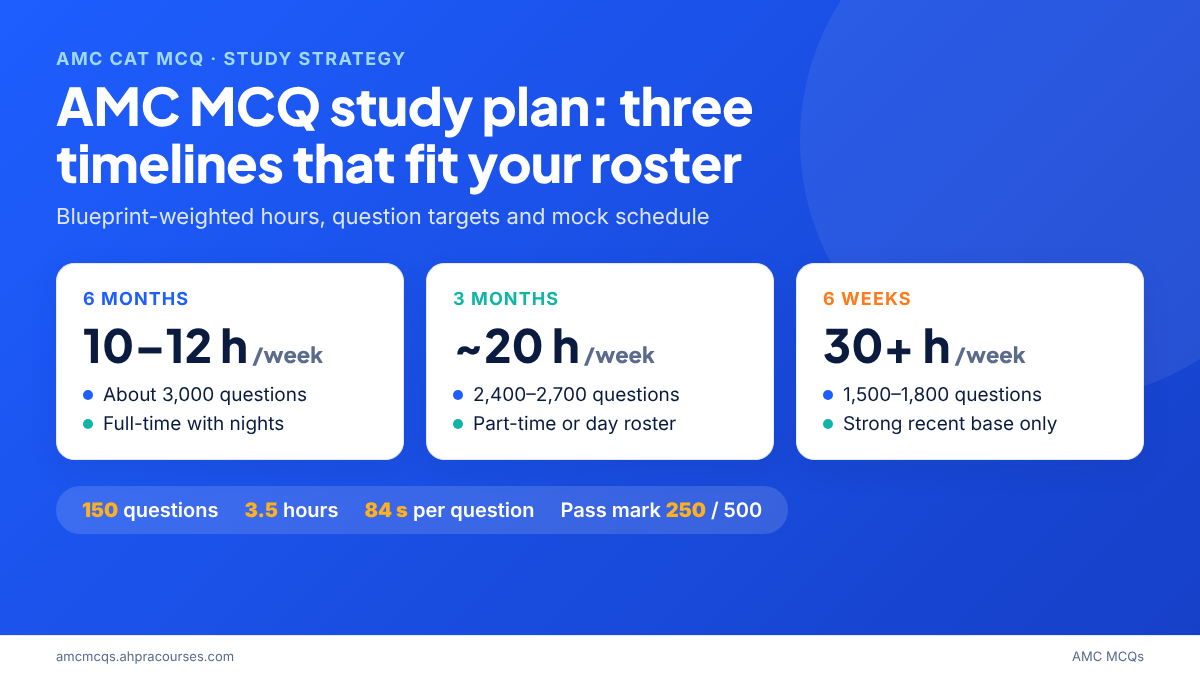
A good AMC MCQ study plan is not a reading list. It is a timetable that matches the exam blueprint, fits around your rosters, and turns 150 questions in 3.5 hours into something you have rehearsed many times before exam day. This guide gives you three complete plans (6 months, 3 months and 6 weeks) as tables, with weekly hours for working doctors, blueprint-weighted time per domain, question targets, a mock exam schedule and revision cycles that make knowledge stick.
Every number below is either taken from the AMC’s own exam specifications or is a planning estimate we explain openly, so you can adjust it to your own starting point.
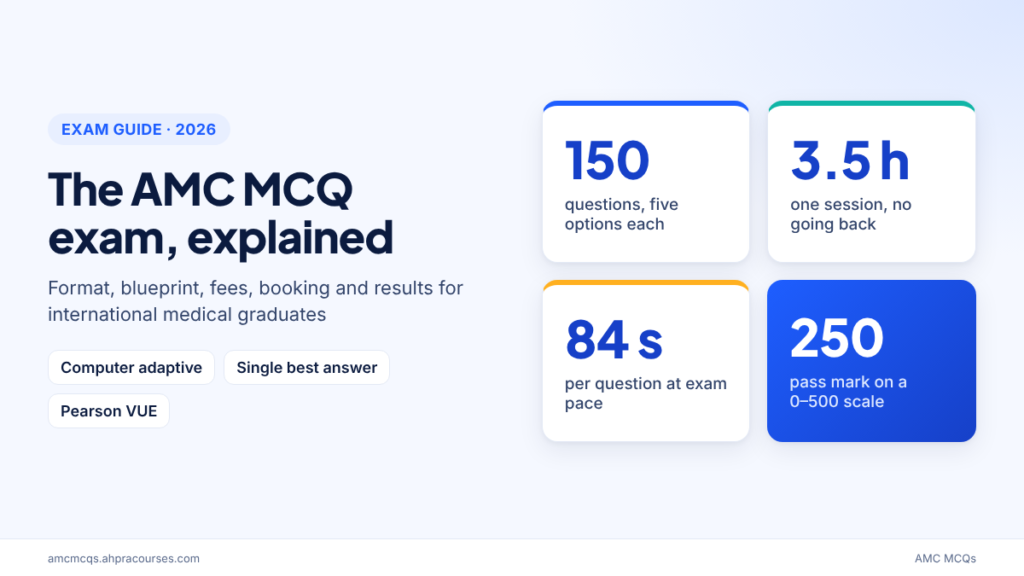
Before choosing a timeline, be clear about the task. The AMC Computer Adaptive Test (CAT) MCQ Examination has 150 questions, each with a stem and five options and one best answer. It runs in a single 3.5-hour session at a Pearson VUE test centre. You must answer each question before the next appears, you cannot go back, and you must finish all 150 items or risk a result of “insufficient data”.
Three features of the exam shape how you should study:
The exam is scored on a 0–500 scale with a pass mark of 250. That is not the same as getting 50% of questions right, because the test adapts to you. Our guide to the AMC MCQ pass mark and scoring explains how it works. For the full exam overview, start with the complete AMC MCQ exam guide.
The AMC does not publish a recommended number of study hours. What follows is a planning estimate based on the work involved: about 2,000–3,000 practice questions at roughly 4 minutes each (84 seconds to answer plus 2–3 minutes to review), plus focused reading on weak areas and Australian guidelines. That adds up to about 200–300 hours for most candidates.
Adjust the estimate to your starting point:
Most IMGs prepare while working. Be honest about what your roster allows, then choose the timeline that fits. Do not choose the timeline first and hope the hours appear.
| Your work pattern | Realistic study hours per week | Timeline that fits |
|---|---|---|
| Full-time with nights or on-call (50+ h/week) | 8–12 | 6 months |
| Full-time day roster (38–45 h/week) | 12–18 | 4–6 months |
| Part-time (about 20–25 h/week) | 18–25 | 3 months |
| Not currently working (study leave, between jobs) | 30–40 | 6–10 weeks |
A useful rule: on a working weekday, protect at least one 60–90 minute block (for example, 30 timed questions plus review). Use days off for longer blocks and full simulations.
Exam tip: Book your exam date first, then build the plan backwards from it. AMC authorisation is valid for 12 months and you can book only one event within it, so a fixed date stops the plan drifting.
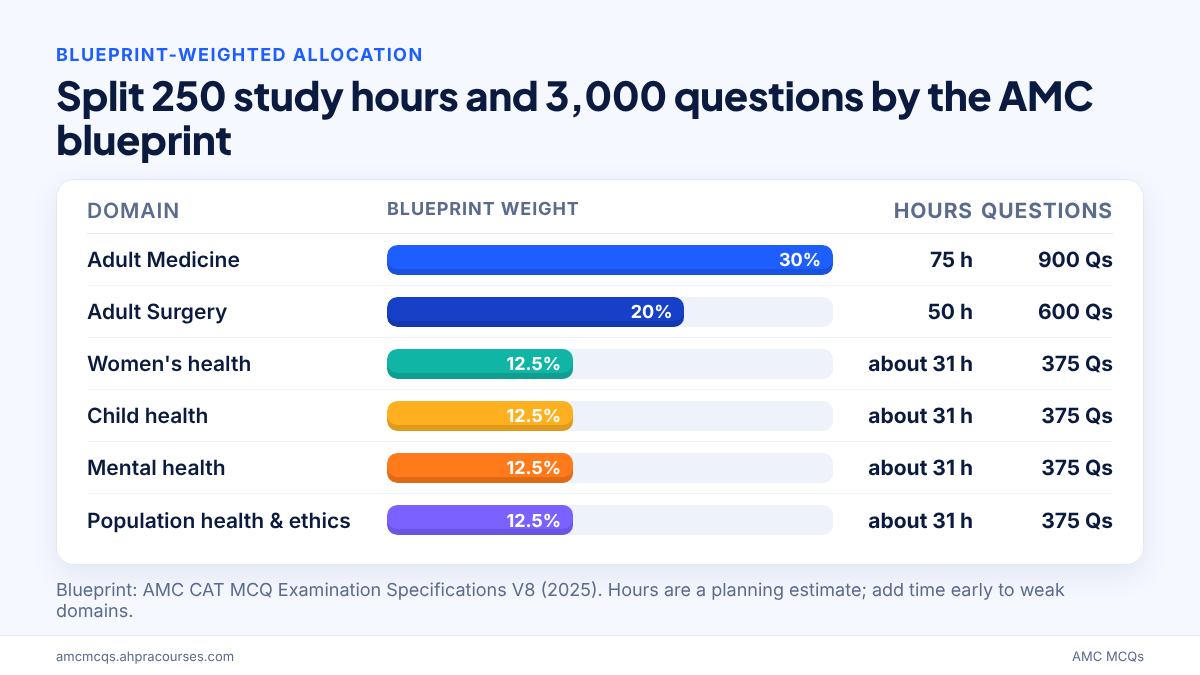
The fairest way to share your time is to follow the published blueprint. If 30% of the exam is Adult Medicine, about 30% of your questions and study hours should be too. The table converts the blueprint into hours, questions and days for a 250-hour plan and a 3,000-question bank.
| Domain | Blueprint weight | About how many exam questions (of 150) | Hours in a 250-hour plan | Questions out of 3,000 | Study days out of 40 |
|---|---|---|---|---|---|
| Adult health – Medicine | 30% | 45 | 75 | 900 | 12 |
| Adult health – Surgery | 20% | 30 | 50 | 600 | 8 |
| Women’s health (O&G) | 12.5% | about 19 | about 31 | 375 | 5 |
| Child health | 12.5% | about 19 | about 31 | 375 | 5 |
| Mental health | 12.5% | about 19 | about 31 | 375 | 5 |
| Population health and ethics | 12.5% | about 19 | about 31 | 375 | 5 |
Two adjustments make this split work better in practice:
This is the best plan for doctors working full-time with nights or on-call. It totals about 260–310 hours. The pace is slow enough to absorb Australian guidelines properly and leaves room for missed weeks.
| Month | Focus | Weekly targets | Milestone |
|---|---|---|---|
| 1 | Baseline and foundations: read the AMC specifications and sample questions; sit a timed 150-question baseline in week 1; start Adult Medicine (cardiology, respiratory, endocrine) | 10 h; 100–120 questions in tutor mode | Baseline score by domain; error log set up |
| 2 | Finish Adult Medicine (renal, gastro, neurology, haematology, infectious diseases); begin Population health and ethics | 10–12 h; 120–150 questions | Medicine first pass done |
| 3 | Adult Surgery (acute abdomen, trauma, vascular, breast, urology, orthopaedics); Women’s health | 10–12 h; 150 questions, half of them timed | Domain review of weakest 3 subtopics |
| 4 | Child health and Mental health; Australian guideline layer (screening, immunisation, Mental Health Acts) | 12 h; 150 questions, mostly timed | Second full timed simulation (end of month 4) |
| 5 | Second pass across all domains, guided by analytics; redo all incorrect questions | 12 h; 150–180 timed questions | Every domain attempted at least twice |
| 6 | Exam conditions: full mock, error-log revision, high-yield topics; taper in the final week | 12 h in weeks 1–3, 6–8 h in week 4 | Full mock 2–3 weeks before the exam |
Question total for this plan: about 3,000 questions, or the whole of a large bank, plus a redo of every question you got wrong.
This suits part-time workers and full-time doctors on a day roster who can protect weekends. It totals about 240–260 hours. It is intensive, so the plan front-loads the two big domains and moves into timed work early.
| Weeks | Focus | Questions per week | Notes |
|---|---|---|---|
| 1 | Specifications, sample items, timed baseline (150 questions) | 150 (baseline) + 50 | Set domain priorities from the baseline |
| 2–4 | Adult Medicine | 200–220 | Tutor mode for week 2, timed from week 3 |
| 5–6 | Adult Surgery | 200 | Include trauma priorities and post-operative complications |
| 7 | Women’s health | 200 | Antenatal care, screening, early pregnancy bleeding |
| 8 | Child health | 200 | Immunisation schedule, febrile child, development |
| 9 | Mental health; second timed simulation at the end of the week | 200 + 150 simulation | Compare with the baseline by domain |
| 10 | Population health and ethics | 200 | Biostatistics calculations, consent, confidentiality |
| 11 | Mixed timed blocks; redo incorrect; full mock | 250 + mock | Mock under strict 3.5-hour conditions |
| 12 | Error log, Australian guidelines, light mixed blocks | 100–150 | Taper; rest the day before |
Question total: about 2,400–2,700 questions. If you fall behind, cut tutor-mode reading, not timed practice.
Six weeks is enough only if you have a strong recent clinical base, are not working full-time, or are resitting after a near-pass. It totals about 180–220 hours and depends almost entirely on timed questions with careful review.
| Week | Focus | Questions | Daily structure (5–6 days a week) |
|---|---|---|---|
| 1 | Baseline simulation; Adult Medicine | 150 + 250 | 2 timed blocks of 30 questions, then review and targeted reading |
| 2 | Adult Medicine and Adult Surgery | 300 | Morning block in your weakest domain, afternoon mixed block |
| 3 | Adult Surgery and Women’s health | 300 | Same pattern; start the Australian guidelines notes |
| 4 | Child health and Mental health; simulation at the end of the week | 300 + 150 | Simulation on your day off |
| 5 | Population health and ethics; redo incorrect; full mock | 250 + mock | Mock 10–14 days before the exam |
| 6 | Error log, weak subtopics, rest | 100–150 | Half days; nothing new in the last 48 hours |
Question total: about 1,500–1,800 questions. If your timed scores are still well below target at the end of week 4, consider moving the exam date (if you are still before the event’s closing date) rather than sitting under-prepared.
Exam tip: You can change or withdraw from your booking without penalty only before the event’s closing date, and only if seats are available. After that you cannot change it. Put the closing date in your calendar the day you book.
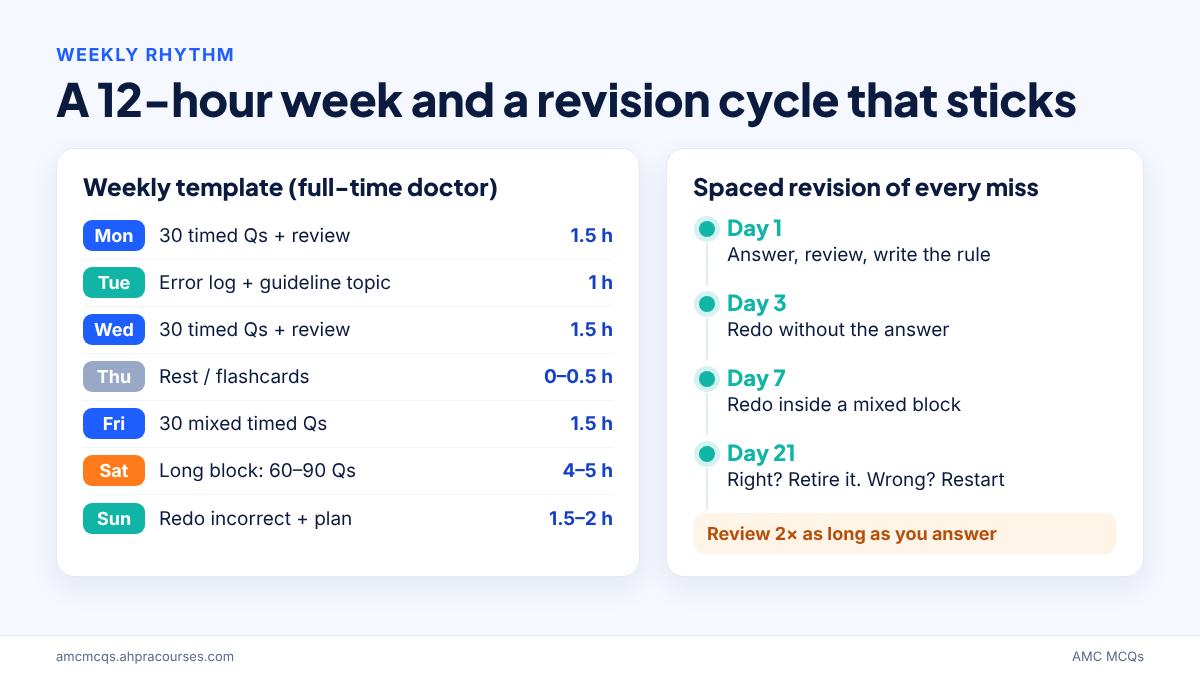
Plans fail at the level of the week, not the month. This template gives about 12 hours for a full-time doctor and can be scaled up.
| Day | Session | Time |
|---|---|---|
| Monday | 30 timed questions (current domain) + review | 1.5 h |
| Tuesday | Error-log revision + one Australian guideline topic | 1 h |
| Wednesday | 30 timed questions (current domain) + review | 1.5 h |
| Thursday | Rest or a 20-minute flashcard review only | 0–0.5 h |
| Friday | 30 mixed timed questions (all domains) + review | 1.5 h |
| Saturday | Long block: 60–90 timed questions, review, targeted reading on the 3 weakest subtopics | 4–5 h |
| Sunday | Redo incorrect questions from the week; plan next week | 1.5–2 h |
On night-shift weeks, swap the weekday sessions for two longer sessions on your days off. Do not study straight after a night shift: you will remember little and lose sleep you need.
Doing 3,000 questions badly is worth less than doing 1,500 well. Use the bank in three modes, in this order:
Spend about twice as long reviewing as answering. For a 42-minute block, that is roughly 80 minutes of review. In the review, record each miss in an error log with four fields:
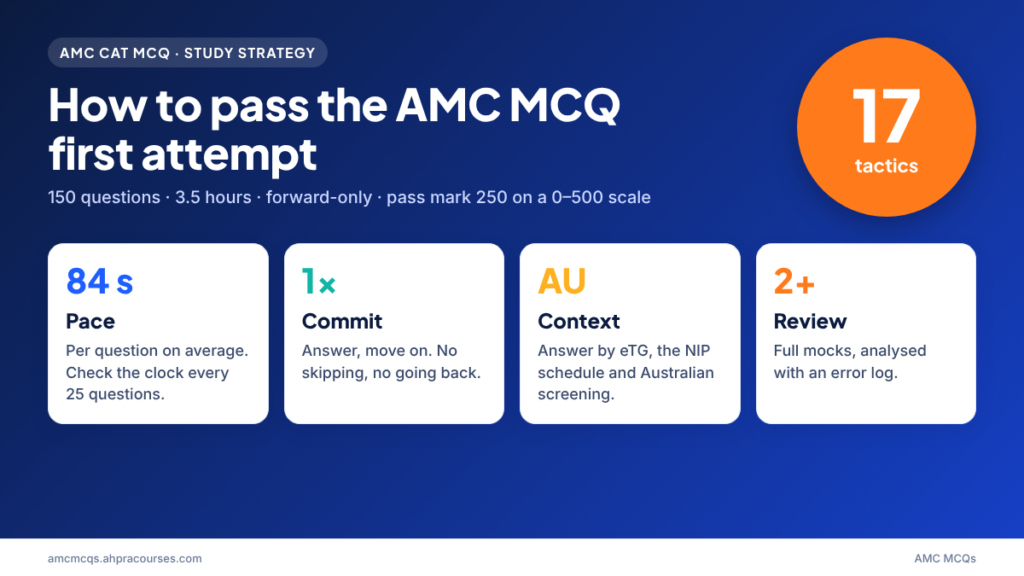
Pay attention to the “why” column. If more than a third of your errors are misreads or timing, the fix is more timed practice, not more reading. Our guide on how to pass the AMC MCQ on your first attempt covers pacing and exam-day tactics in detail.
Here is the kind of question to put in your error log. Try it in 84 seconds.
A 2-year-old boy is brought to the emergency department at 2 am with a barking cough that started tonight. He is alert and well perfused. He has stridor at rest when calm, a respiratory rate of 38 breaths per minute, and mild subcostal recession. Oxygen saturation is 97% on room air. What is the most appropriate initial management?
Answer: B. Stridor at rest with increased respiratory rate and recession, in an alert, well-perfused child, is moderate croup. Australian paediatric guidance (Royal Children’s Hospital Melbourne) recommends oral dexamethasone 0.15 mg/kg (or prednisolone 1 mg/kg) for moderate croup, with nebulised adrenaline considered if symptoms persist or worsen. Salbutamol (A) treats lower airway bronchospasm, not upper airway oedema. Croup is a clinical diagnosis, so X-rays and antibiotics (C) are not routinely used. Humidified air (D) has not been shown to change severity, and a child with stridor at rest should not be discharged. Routine oxygen (E) is not needed with normal saturations; if oxygen is needed, treat it as severe obstruction.
Error-log entry: “Moderate croup = stridor at rest + increased work of breathing in a well child → oral dexamethasone 0.15 mg/kg. Never discharge with stridor at rest.”
A full simulation is the only way to test your pacing and stamina together. Plan for three or four in total, spaced like this:
| Simulation | 6-month plan | 3-month plan | 6-week plan | Purpose |
|---|---|---|---|---|
| Baseline | Week 1 | Week 1 | Week 1 | Find weak domains; feel the 84-second pace |
| Midpoint | End of month 4 | End of week 9 | End of week 4 | Check that weak domains are improving |
| Full mock | 2–3 weeks before the exam | Week 11 | 10–14 days before the exam | Final rehearsal under strict conditions |
| Optional final | 7–10 days before | Not needed | Not needed | Confidence and pacing only |
Do not sit a full simulation in the last 3–4 days before the exam. You need the energy, and a bad score that close to the exam helps nobody.
Most candidates forget a lot of what they read within weeks unless they revisit it. Build spaced revision into the plan instead of hoping to “go over everything” at the end.
Use the redo-incorrect and bookmark features each Sunday to pull the week’s misses into one block. In the final month, your error log becomes your main revision text. It is personal, short and drawn from your actual weaknesses.
Many IMGs lose marks not because they lack knowledge but because they answer according to the guidelines of their home country. Set aside one session a week for Australian specifics: national screening programs and their ages and intervals, the National Immunisation Program schedule, Therapeutic Guidelines antibiotic choices, absolute cardiovascular risk assessment, Mental Health Act principles and Aboriginal and Torres Strait Islander health. Our article on Australian guidelines for the AMC MCQ sets these out in tables. Pair it with the list of AMC MCQ high yield topics so you know which conditions to master first in each domain.
A 3- or 6-month plan alongside clinical work is a marathon. Most candidates who burn out do so in the middle third, when the novelty has gone and the exam still feels far away. Plan for this.
If stress is affecting your health or work, speak to your GP or an employee assistance program. Doctors’ health advisory services also operate in each state and territory.
Every plan meets a bad week. Use these rules instead of starting again from scratch:
| Problem | What to change |
|---|---|
| Missed a week (illness, roster change) | Do not try to double up. Drop the lowest-priority reading, keep timed questions and push the next topic back a week. |
| One domain stays weak after two passes | Use weak-area drills: 20 questions a day in that domain for 10 days, plus a one-page summary of its top 10 topics. |
| Running out of time in timed blocks | Practise blocks of 10 questions in 14 minutes. Commit to an answer by 84 seconds, then move on. |
| Scores flat for 3+ weeks | Audit the error log. If most errors are “non-Australian answer”, add the guidelines layer; if most are misreads, slow down on the final line of each stem. |
| Midpoint simulation well below target | Consider moving your exam date while you are still before the event’s closing date. |
Your AMC MCQ authorisation includes free access to the AMC’s MCQ Preparation App, built with eMedici, with 210 questions. Use it alongside a larger bank. Our guide to AMC MCQ preparation resources compares the options by budget.
Most candidates need about 200–300 focused hours. For a working doctor, that usually means 3–6 months at 10–20 hours a week. A 6-week plan is realistic only if you have a strong recent clinical base and can study 30 or more hours a week.
Aim for about 2,000–3,000 questions, each one properly reviewed, plus a redo of every question you got wrong. Quality of review matters more than the total: spend about twice as long reviewing as answering.
Yes, most IMGs do. Protect one 60–90 minute block on most working days and one longer block on a day off, for about 10–12 hours a week. A 6-month timeline usually fits a full-time roster with nights or on-call.
Follow the blueprint: 30% Adult Medicine, 20% Adult Surgery, and 12.5% each for Women’s health, Child health, Mental health, and Population health and ethics. Give extra time early to domains where your baseline is weak, then return to the blueprint split in the final month.
Sit a timed baseline in week 1, a midpoint simulation about two-thirds of the way through, and a full mock 10–21 days before the exam. Avoid full simulations in the last 3–4 days so you arrive rested.
It can be for candidates who graduated recently, work in broad acute medicine, or narrowly missed a previous attempt, and who can study 30+ hours a week. If your midpoint simulation is well below target, consider moving your date while changes are still allowed.
No. The AMC states that many reconstructed papers circulating online contain incorrect stems and answers. Use the official AMC sample questions and preparation app, original question banks and current Australian guidelines instead.
Answer exam-style AMC MCQs on this topic with an explanation for every option. 60 questions are free.
A complete guide to the AMC CAT MCQ for international medical graduates: format, blueprint, scoring, fees, booking with Pearson VUE, results and what comes…
Read the guideSeventeen practical tactics to pass the AMC CAT MCQ first time, from 84-second pacing and forward-only answering to error logs, mock analysis and a…
Read the guideWhat happens after you pass the AMC MCQ: the clinical exam or WBA, the AMC Certificate, limited or provisional registration, 12 months of supervised…
Read the guide