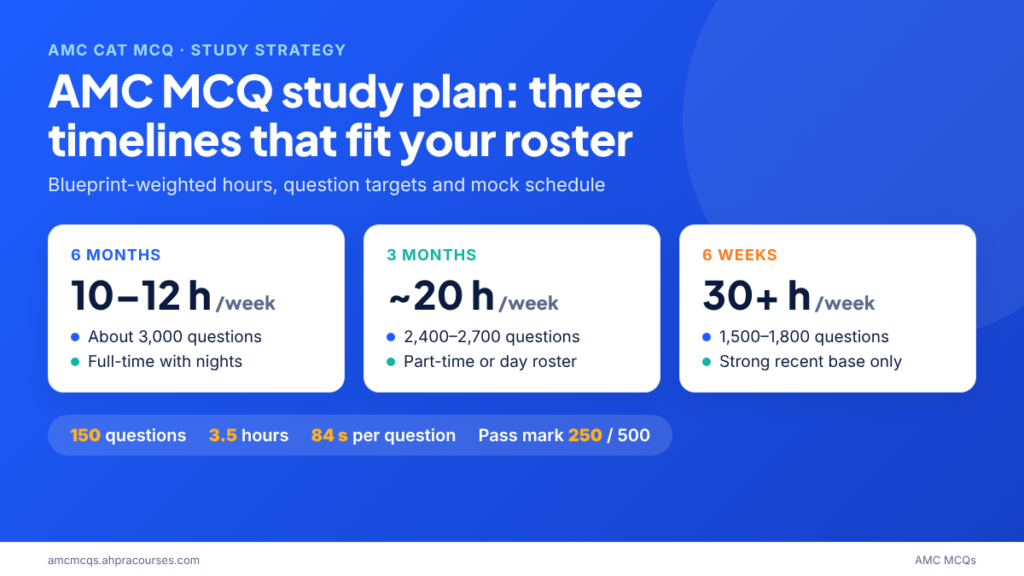
How to Build an AMC MCQ Study Plan Around a Full-Time Roster
Three complete AMC MCQ study plans (6 months, 3 months and 6 weeks) with weekly hours for working doctors, blueprint-weighted domain time, question targets…
Read the guideWhy 250 out of 500 is not 50%: how the AMC CAT MCQ is scored, how adaptivity and pretest items work, how to read your results and what to do after a fail.
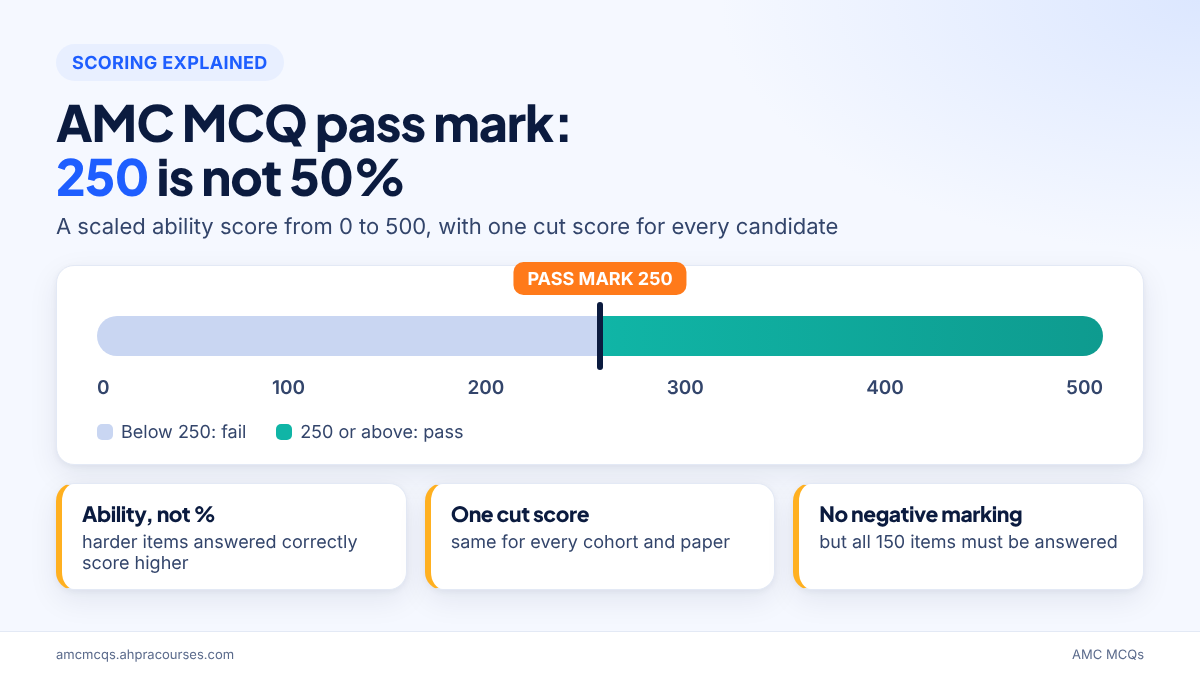
The AMC MCQ pass mark is 250 on a scale from 0 to 500. That single number causes more confusion among international medical graduates than any other part of the exam, because almost everyone’s first instinct is to read it as “50% correct”. It is not, and understanding why will change how you prepare, how you pace yourself and how you read your result.
This guide explains how the AMC Computer Adaptive Test (CAT) MCQ is scored, how adaptivity works, why some questions do not count, what the AMC has said about the pass standard for 2026, how to read your results and what to do if you fall short. Everything here is drawn from the AMC’s own published specifications and candidate pages.
According to the AMC CAT MCQ Examination Specifications (version 8, September 2025), results are reported on a scale from 0 to 500, and a score of 250 is a pass. The AMC describes this as a single pass/fail cut score that applies to the whole examination.
Three features of that cut score matter to you:
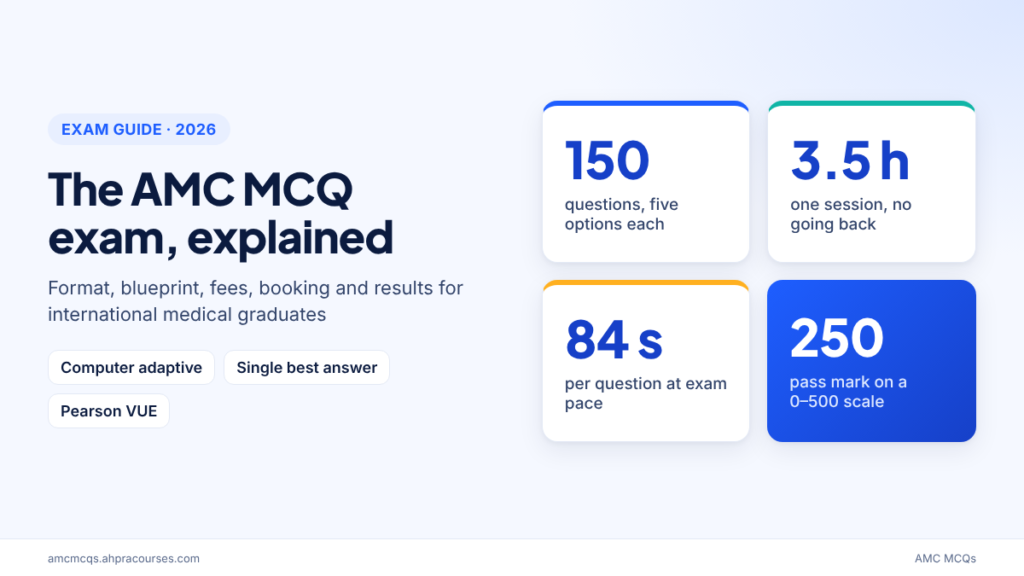
The exam itself is 150 single-best-answer questions with five options each, taken in one 3.5-hour session at a Pearson VUE test centre. If you are new to the format, start with our complete AMC MCQ exam guide, then come back here for the scoring detail.
A traditional paper exam gives everyone the same questions and counts how many you get right. If the pass mark were 50%, you would need 75 of 150 correct. The AMC MCQ does not work that way.
The specifications state that your score reflects your ability rather than the raw number of questions you answered correctly. Candidates who answer harder questions correctly can score higher than candidates who answer the same number of easier questions correctly. In other words, the difficulty of the questions you get right matters, not just how many.
Think of a high-jump competition where the bar moves after every jump. Clear it and the bar goes up; knock it off and it comes down. At the end, nobody asks how many jumps you cleared. They ask how high you were reliably clearing. That height is your ability estimate, and the AMC converts it to the 0–500 scale.
Two candidates could each answer 90 questions correctly. One spent most of the exam on moderate questions; the other spent most of it on difficult ones. Their raw counts match, but their ability estimates, and therefore their scores, do not.
| Common belief | What the AMC actually specifies |
|---|---|
| “250 out of 500 means I need 50% correct.” | The score estimates ability; it is not a percentage of correct answers. |
| “The pass mark moves depending on my cohort.” | A single cut score applies regardless of cohort. |
| “Getting an easier paper is lucky.” | Each CAT exam is equated to the others, so no paper is easier in scoring terms. |
| “Every question counts.” | New, uncalibrated items do not count until calibrated, but you cannot identify them. |
| “Wrong answers lose marks.” | No marks are deducted for incorrect answers. |
Exam tip: Stop trying to count your correct answers during the exam. Because questions are targeted at your level, you will get a fair number wrong however well you are doing. Your sense of “I must be failing” is not reliable evidence.
The AMC publishes the basic logic of its adaptive algorithm. It runs like this:
Every CAT exam is automatically equated to the other tests drawn from the AMC pools. This is what allows the AMC to apply one cut score to candidates who saw entirely different questions.
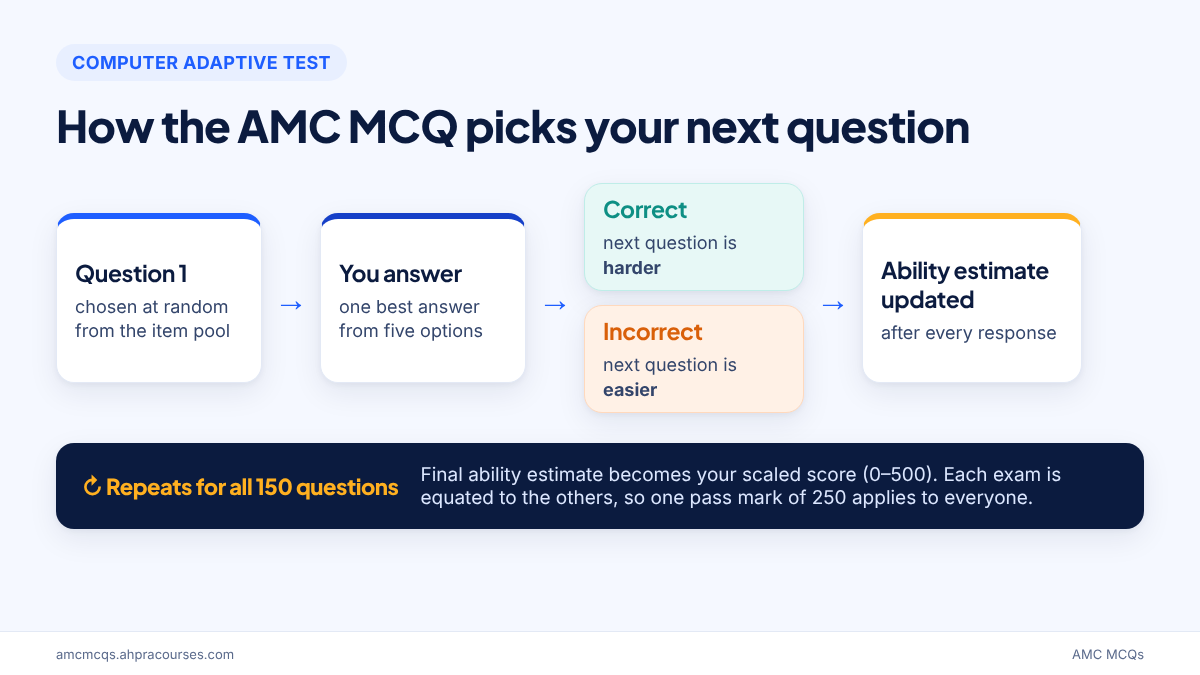
The AMC does not publish item difficulty values, the exact scoring model or claims that early questions carry more weight. Be wary of anyone who tells you otherwise with confidence. Our guide to passing the AMC MCQ on your first attempt turns these principles into pacing and guessing tactics.
At least half of the questions in your exam come from a pool of previously calibrated items, meaning the AMC already knows how difficult they are from earlier candidates’ responses. The remaining questions are new items that have not been used before. Their responses are inspected and calibrated before the items are used for scoring.
What this means in practice:
To see what “harder” means in an adaptive exam, compare these two original population health questions on diagnostic test accuracy. The first asks you to apply a definition. The second makes you work through prevalence, which is the kind of step up you might meet after a run of correct answers. Neither is a recall.
A new rapid test for a bacterial infection is evaluated in a hospital laboratory. Of 200 patients with culture-confirmed infection, 180 test positive. Of 300 patients without infection, 285 test negative. What is the sensitivity of the rapid test?
Answer: D. Sensitivity is the proportion of people with the disease who test positive: 180 ÷ 200 = 90%. E (95%) is the specificity, 285 ÷ 300, the proportion without disease who test negative. B (92.3%) is the positive predictive value in this sample, 180 ÷ (180 + 15). C (93.4%) is the negative predictive value, 285 ÷ (285 + 20). A (36%) is the proportion of all 500 tested who were true positives, which is not a measure of test accuracy.
A state health department considers using the same test to screen 10,000 asymptomatic adults in a community where the prevalence of infection is 2%. The test has a sensitivity of 90% and a specificity of 95%. A participant receives a positive result. What is the probability that this person truly has the infection?
Answer: B. Of 10,000 people, 200 are infected and 9,800 are not. True positives = 90% of 200 = 180. False positives = 5% of 9,800 = 490. Positive predictive value = 180 ÷ (180 + 490) = 180 ÷ 670 = 26.9%. A is the prevalence, the pre-test probability. C is the sensitivity and D the specificity; neither tells you the chance that a positive result is real. E is the negative predictive value, 9,310 ÷ 9,330. The lesson is that at low prevalence even a good test produces many false positives, a core principle when judging screening programs.
Both questions test the same 2×2 table. The second demands an extra step and a conceptual insight. An adaptive exam keeps raising the bar this way, which is why genuine understanding scores better than memorised formulas. Our guide to AMC ethics and population health questions works through more calculations of this kind.
The AMC has advised candidates of an update to the pass standard for 2026 sittings; the reported pass mark is still 250. Check the current specifications before you sit.
Several preparation providers have published their own interpretations and numbers. The AMC has not published a new reported pass mark, so treat any figure other than 250 with caution and rely on what the AMC says in its current specifications and candidate communications.
What should you do differently? Very little, if your preparation is sound:
| Rule (AMC specifications) | What it means for you |
|---|---|
| Marks are not deducted for incorrect answers | Never leave a question unanswered; eliminate what you can and choose. |
| You must answer each item before the next appears | No skipping. Commit to your best answer within your time budget. |
| You cannot return to earlier items | There is no review screen at the end, so do not “park” doubts. |
| You must complete all 150 items | An unfinished exam may be recorded as “Fail – insufficient data to obtain result”. |
| On-screen timer, 3.5 hours total | About 84 seconds per item. Check progress at fixed points, such as every 25 questions. |
| Keystrokes saved every three seconds | A technical fault will not wipe your answers; the AMC Results Panel can review partial responses. |
Exam tip: Use checkpoints. At 84 seconds per question, you should have finished about 25 questions at 35 minutes, 50 at 70 minutes, 75 at 1 hour 45 minutes and 100 at 2 hours 20 minutes. If you are more than five minutes behind, speed up on questions you recognise rather than rushing the hard ones.
If a power cut or computer failure stops your exam, the AMC MCQ Results Panel may analyse your partial responses. If no reliable conclusion can be drawn, a new exam may be arranged at no extra fee, although the AMC does not cover travel or other costs.
Results are released for download in your AMC account at 4.00pm (AEST or AEDT) on the Friday three weeks after your exam event. They are issued by the AMC, not Pearson VUE, and are never given over the phone. Exact release dates for each event are listed on the AMC candidates website.
To find your result, sign in to your AMC account, select “AMC assessments”, choose MCQ Results and then open the exam under Details. Each candidate receives a computer-generated transcript of results together with feedback on their performance.
The AMC no longer offers verification of MCQ results, so there is no paid re-mark. If you have a concern about how your exam was conducted, raise it through the test centre.
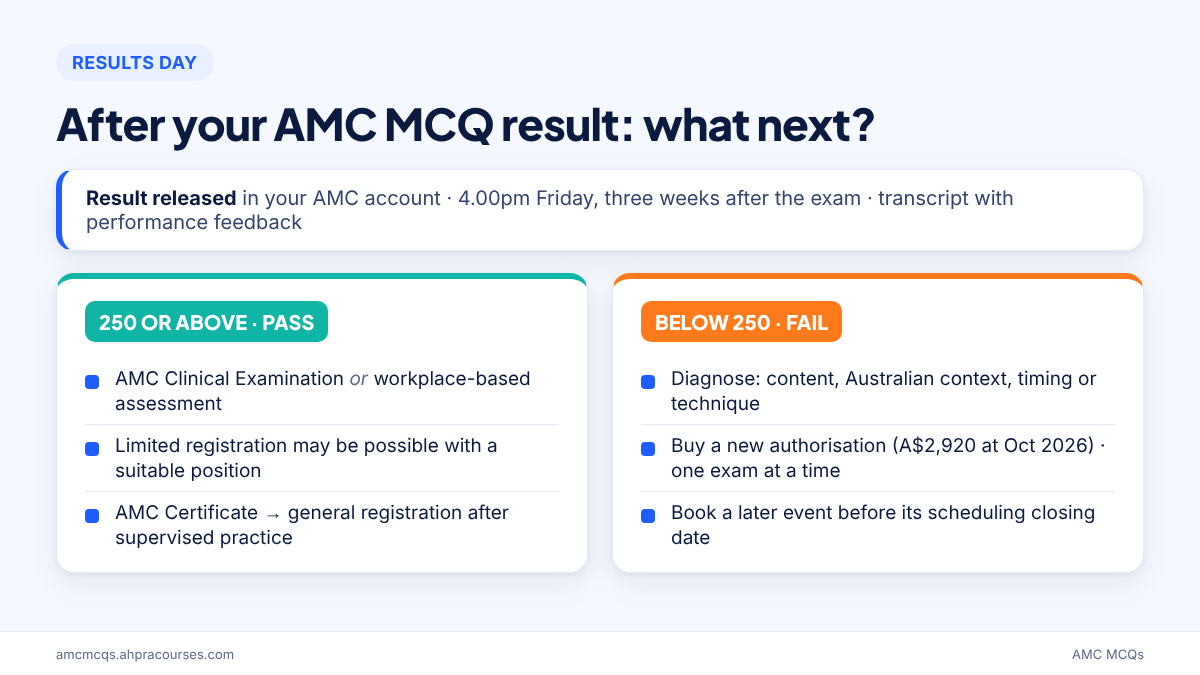
A score below 250 means your estimated ability did not reach the AMC standard on that occasion. It is not a judgement about your worth as a doctor, and it tells you exactly what to work on next.
A “Fail – insufficient data to obtain result” is different. It means you did not complete enough of the exam for a reliable ability estimate. The fix for that is pacing, not more content.
When a result is a fail, work out which of these applies to you:
Each cause needs a different fix. Content gaps need targeted revision with Australian sources; technique problems need timed blocks and an error log.
The AMC does not publish a maximum number of attempts at the CAT MCQ. The rules that do apply are:
Because scheduling closes several weeks before each event, your next sitting will not be immediate. Plan your finances and leave around it. Our AMC MCQ fees, booking and dates guide explains authorisations, changes and refunds step by step.
You cannot game an adaptive exam, but you can prepare for it. The approaches that reliably move candidates past 250 are:
The AMC MCQ is scored on a scale from 0 to 500 and the pass mark is 250. It is a single cut score for the whole exam, applied regardless of your cohort or the specific questions you received.
No. The AMC states that your score reflects your ability rather than your raw number of correct answers. Because the test is adaptive, candidates who answer harder questions correctly can score higher than those with the same number correct on easier questions.
There is no fixed number. The result depends on the difficulty of the questions you answer correctly, not just how many, so no one can give you a valid target count or percentage for passing.
The AMC has advised candidates of an update to the pass standard for 2026 sittings, but the reported pass mark is still 250. Check the current AMC specifications before you sit, and treat unofficial figures with caution.
No. At least half come from a pool of calibrated questions; the rest are new questions that are calibrated before they are used for scoring. You cannot tell which is which, so treat every question as if it counts.
No. Marks are not deducted for incorrect answers. However, you must answer all 150 questions, because an unfinished exam may be recorded as a fail due to insufficient data.
You cannot apply for another exam until you receive the result of the one you sat, which is released three weeks after the exam. You then need a new authorisation and must book a later event before its scheduling closing date.
Answer exam-style AMC MCQs on this topic with an explanation for every option. 60 questions are free.
Three complete AMC MCQ study plans (6 months, 3 months and 6 weeks) with weekly hours for working doctors, blueprint-weighted domain time, question targets…
Read the guideA complete guide to the AMC CAT MCQ for international medical graduates: format, blueprint, scoring, fees, booking with Pearson VUE, results and what comes…
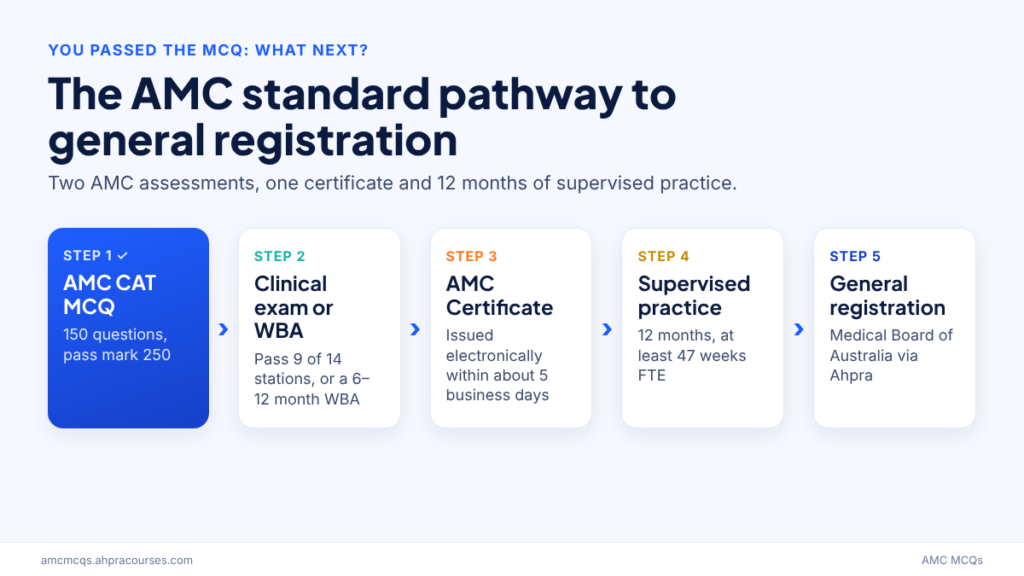
Read the guideWhat happens after you pass the AMC MCQ: the clinical exam or WBA, the AMC Certificate, limited or provisional registration, 12 months of supervised…
Read the guide