AMC MCQ Pass Mark and Scoring Explained: What 250 Really Means
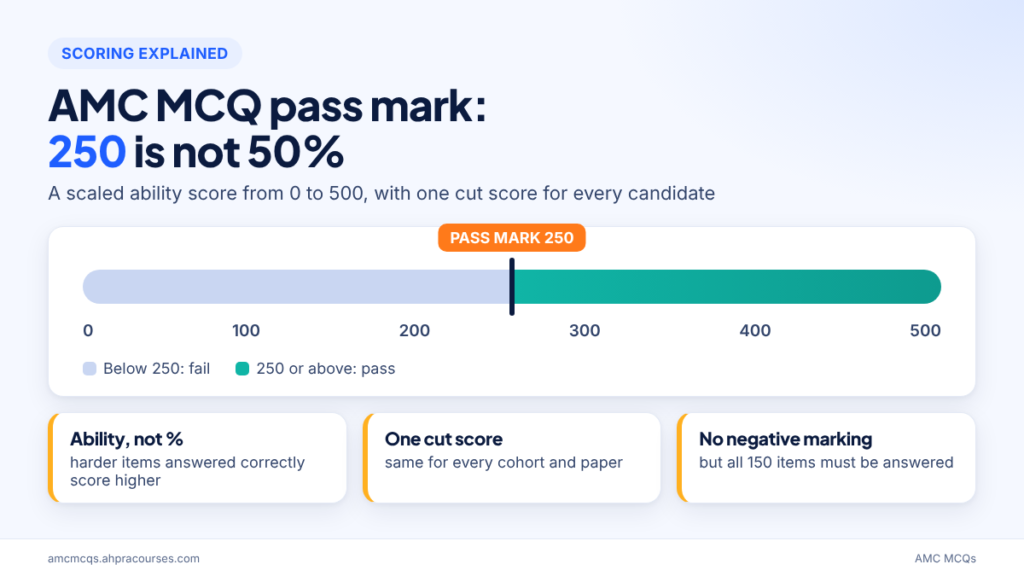
Why 250 out of 500 is not 50%: how the AMC CAT MCQ is scored, how adaptivity and pretest items work, how to read…
Read the guideWhich AMC MCQ preparation resources are worth your time: the official AMC specifications and app, the Australian guidelines that decide the best answer, how to use a question bank properly, and a stack for every budget.
Choosing AMC MCQ preparation resources is harder than it should be. Search results are full of question banks, recall PDFs, courses and textbook lists, and most international medical graduates end up paying for more than they can use while still missing the Australian guidelines that decide the right answer.
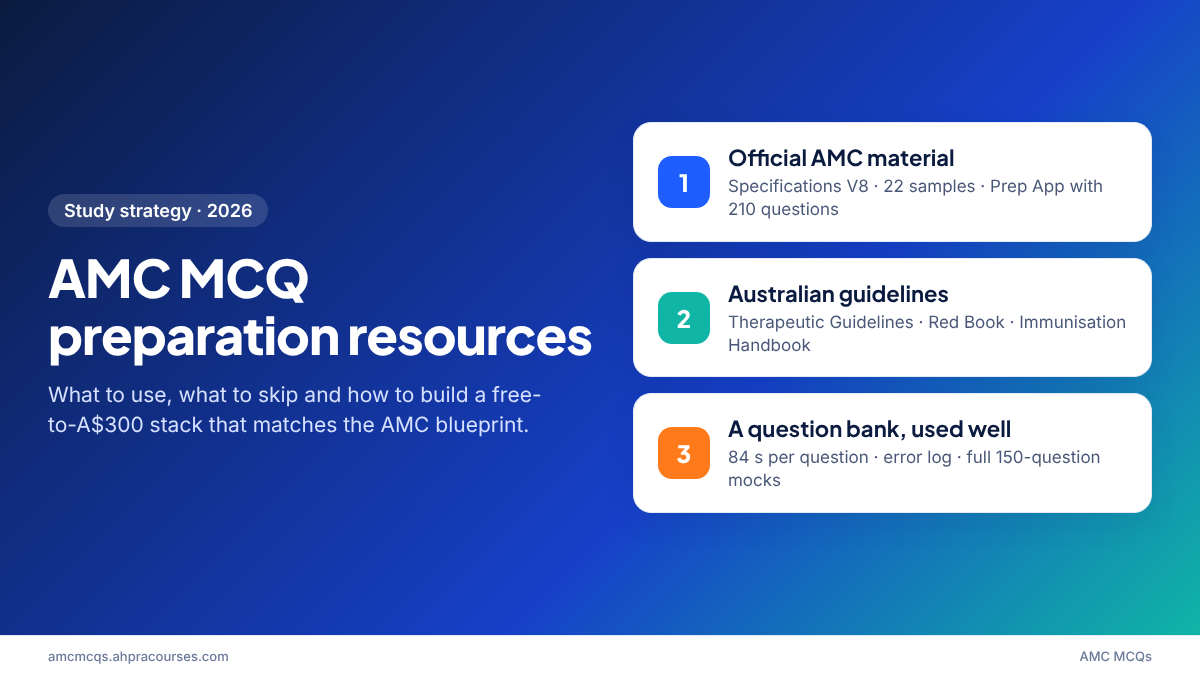
This guide sorts what is worth your time into three layers: the official AMC material that defines the exam, the Australian clinical references that define the “best” answer, and the question bank you use to practise under time pressure. It explains how to use each one, why recalls are a risk, which resources are free, and which stack to build for your budget.
Every useful resource fits into one of three jobs. Problems start when candidates use a resource for the wrong job, such as trying to learn Australian antibiotic choices from a question bank or practising timing with a textbook.
A balanced plan uses all three every week. Our AMC MCQ study plan shows how to split hours between reading and questions for 6-month, 3-month and 6-week timelines.
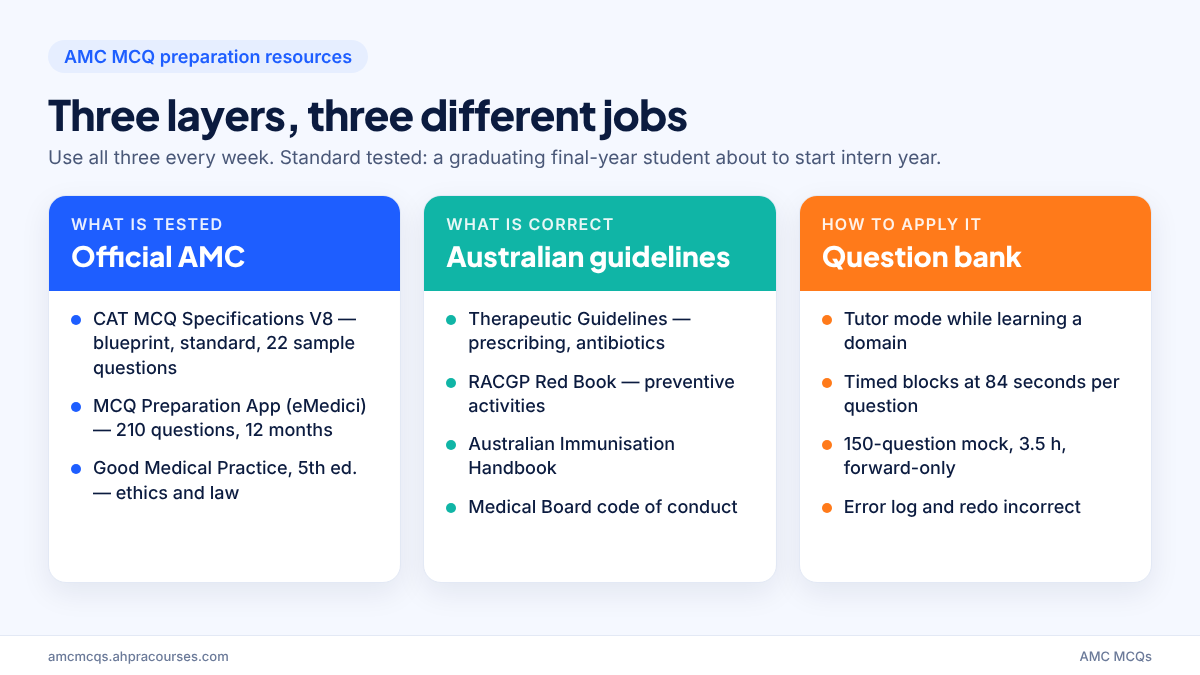
The AMC itself lists only a few preparation resources on its MCQ page. Each is worth using fully before you spend money elsewhere.
The specifications are a free PDF on the AMC website; the current version is V8, dated September 2025. They are the closest thing to a rulebook, and they answer questions candidates often pay others to answer:
Use it three ways. First, turn the blueprint into your time allocation. Second, sit the 22 sample questions untimed early on to learn the style. Third, reread the standard whenever you find yourself studying registrar-level detail: the exam rewards safe, common, first-line decisions.
The AMC produced the MCQ Preparation App in partnership with eMedici. When you buy an MCQ authorisation, the AMC emails you a unique link to set up access. What you get:
The AMC and eMedici are independent organisations. The AMC provides access only to its own MCQ questions; eMedici’s other products are separate and were not developed by the AMC. Because these 210 items are the most authentic practice available, do not burn them in week one. Use about a third as a baseline once you have revised the blueprint once, a third midway, and the last third in your final month as a confidence check alongside full mocks.
The specifications refer to an AMC publication called Annotated Multiple Choice Questions. Before buying any copy, check what the AMC currently sells: its publications page at the time of writing describes Good Medical Practice and Australian Medicine in Context, not an MCQ book. Older printed AMC MCQ books circulate second-hand, but they predate the computer adaptive format and current Australian guidelines. Use them, if at all, to understand question style, and check every management point against a current guideline.
This AMC book covers the professional, ethical and legal requirements of practising in Australia: consent, confidentiality, end-of-life care, documentation, complaints, and new chapters on telehealth regulation, data privacy and cross-jurisdictional practice. It is available in print and as an EPUB through major retailers at A$109.99 RRP. It is the most useful single purchase for the Population health and ethics domain, which makes up 12.5% of the exam.
The AMC is preparing Australian Medicine in Context – key presentations and topics for entry to practice to replace the AMC Anthology. It focuses on patient presentations and professional practice, and adds content on Aboriginal and/or Torres Strait Islander health and cultural safety. Check the AMC publications page for whether it is available when you start.
| Official resource | Cost | Best used for |
|---|---|---|
| CAT MCQ Examination Specifications V8 | Free PDF | Blueprint, standard, rules, 22 sample questions |
| AMC MCQ Preparation App (eMedici) | Included with the A$2,920 authorisation | 210 authentic questions as progress checkpoints |
| Good Medical Practice, 5th edition | A$109.99 RRP | Ethics, law and professionalism |
| Australian Medicine in Context | Check availability | Presentation-based Australian context |
| AMC Indigenous Health webpage | Free | Culturally safe practice (recommended on the MCQ page) |
Many AMC MCQ options would be acceptable in India, Pakistan, the UK or the US. The exam asks for the best answer in Australia, so you need the references Australian clinicians use. The specifications also caution that care should be taken with major reference textbooks, because they go well beyond the standard tested. Use the references below to check decisions, not to read cover to cover. Our guide to Australian guidelines for the AMC MCQ sets out the differences that most often catch IMGs.
Therapeutic Guidelines is the independent, non-profit Australian reference for prescribing: 22 guidelines covering about 2,500 conditions with treatment advice. It is the reference behind most “first-line drug” and “empirical antibiotic” questions. It is a paid subscription for individuals and institutions, but two things help:
If you already work in an Australian health service, ask whether you have institutional access before you buy.
Murtagh’s General Practice (now in its 9th edition, McGraw Hill) is a long-standing Australian general practice text organised around presentations, with red flags and a “diagnostic strategy” approach that suits AMC stems well. The companion handbook is a shorter version. Use it to understand how an Australian GP approaches a presentation, and check drug choices against Therapeutic Guidelines.
The RACGP’s Guidelines for preventive activities in general practice, known as the Red Book, is in its 10th edition and maintained as a web-based document with a PDF download. It is the reference for who to screen, how often and for what, which drives a large share of Population health questions.
Recommendations in the Handbook are developed by the Australian Technical Advisory Group on Immunisation (ATAGI) and approved by the NHMRC. It is publicly available online and as an app, and it covers vaccine scheduling, catch-up, special groups and contraindications. Pair it with the National Immunisation Program schedule.
Screening ages and intervals are among the easiest marks to lose, because they differ from other countries. Learn these three cold:
| Program | Test | Who and how often |
|---|---|---|
| National Cervical Screening Program | HPV-based Cervical Screening Test | Every 5 years, ages 25–74 |
| National Bowel Cancer Screening Program | Immunochemical faecal occult blood test (iFOBT) | Every 2 years, ages 45–74 |
| BreastScreen Australia | Screening mammogram | Every 2 years; ages 50–74 invited, 40 and over eligible |
Good medical practice: a code of conduct for doctors in Australia is free on the Medical Board’s website. Ethics questions about consent, confidentiality, boundaries, conflicts of interest and your own health are answered from it. Our AMC ethics and population health guide turns its principles into worked questions.
| If the question asks about… | Check it against |
|---|---|
| First-line drug, dose choice or empirical antibiotic | Therapeutic Guidelines |
| Screening age, interval or eligibility | RACGP Red Book and the national program sites |
| Vaccine timing, catch-up or contraindication | Australian Immunisation Handbook |
| Consent, confidentiality, reporting, boundaries | Medical Board code of conduct; Good Medical Practice |
| How a GP works up a presentation | Murtagh’s General Practice |
| Safe drinking advice | NHMRC alcohol guidelines |
Exam tip: When you get a question wrong because “that is what we do at home”, write the Australian rule and its source in your error log. These differences repeat across many questions, so one correction often fixes several future answers.
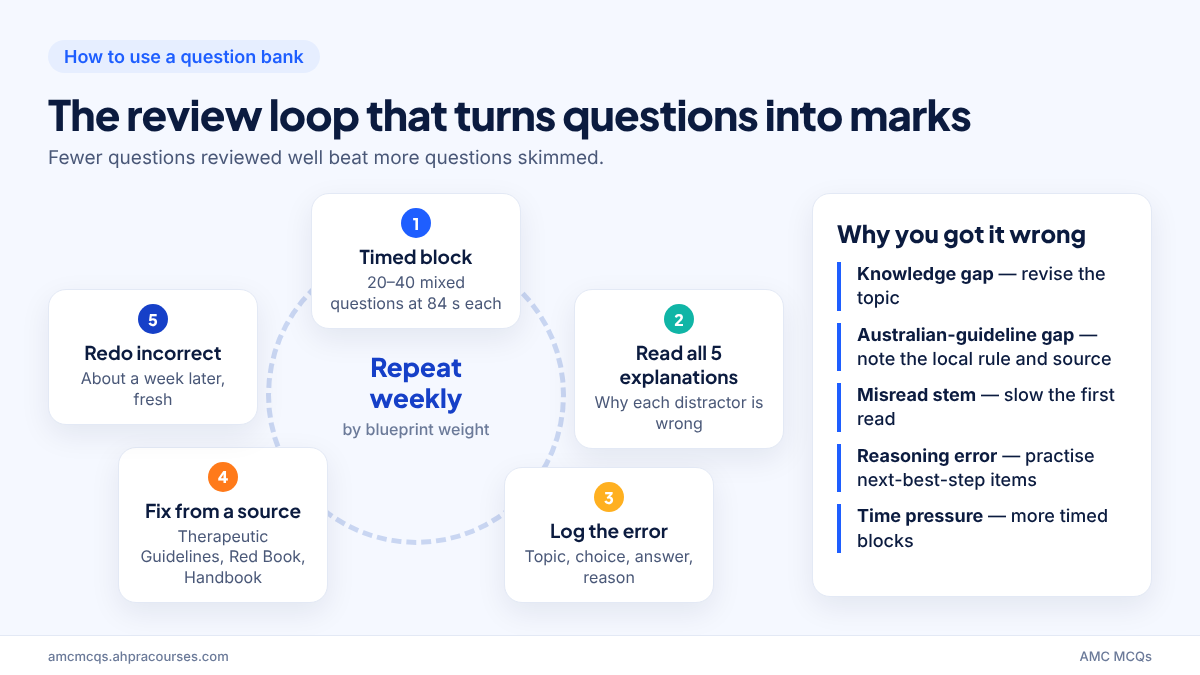
A question bank is the most effective preparation resource you can buy, and also the easiest to waste. Doing 3,000 questions quickly and checking only the score teaches little. Doing fewer questions slowly and well teaches more, and the method matters more than the brand.
For each question, read why the right answer is right and why each of the other four is wrong. The distractors are usually correct answers to slightly different stems. Learning when option B would have been right is how one question teaches you four.
Record every wrong answer, and every right answer you guessed, in a simple table: topic, what you chose, the correct answer, and the reason you missed it. Classify the reason, because each needs a different fix:
Redo incorrect questions after about a week, without looking at your previous answer. Use domain and subtopic analytics to find weak areas, then run short drills on them. Compare your domain performance against the blueprint weights: a weak score in Medicine (30%) costs far more than a weak score in a 12.5% domain.
Try each question, then read the explanation as you would in tutor mode. Both test Australian rules that differ from many IMGs’ home practice.
A 30-year-old woman attends for a routine Cervical Screening Test. She is asymptomatic, not immunocompromised, and her previous screening test five years ago was normal. Today’s result reports that oncogenic HPV was not detected. When should she next be screened?
Answer: D. Under the National Cervical Screening Program, an HPV-not-detected result in an asymptomatic person returns them to routine screening every 5 years (ages 25–74). A 12-month repeat (A) is for an intermediate-risk result, not a negative one. Two years (B) was the interval for the old Pap smear program, which is why it tempts candidates who trained under it. Three years (C) is the interval in several other countries’ cytology-based programs. Ten years (E) is too long for a person within the screening age range. Error log category if you missed it: Australian-guideline gap.
A 46-year-old man asks whether his drinking is within Australian guidelines. He has 3 standard drinks on each of five weeknights and 6 standard drinks on Saturday, and none on Sunday. Which statement best describes his intake against the NHMRC guidelines for healthy adults?
Answer: B. His weekly total is 21 standard drinks (3 × 5 + 6), above the limit of 10 a week, and 6 on Saturday exceeds the limit of 4 on any one day. Option A ignores both limits. Option C wrongly treats 21 a week as acceptable. Option D misses that 6 drinks in one day breaches the daily limit. Option E describes a strategy that is helpful but does not make an over-limit intake within the guidelines. Error log category if you missed it: knowledge gap or arithmetic slip, so read the numbers twice.
For which topics to prioritise in your bank, see our list of AMC MCQ high-yield topics by domain.
“Recall” collections claim to reproduce questions from past sittings. They are tempting when the fee is A$2,920, but the AMC’s own specifications give four reasons to avoid relying on them:
There is also a practical problem. The exam is adaptive and draws from a large pool of calibrated questions, with new items being trialled, so the chance of meeting a remembered stem in your sitting is small. Understanding a topic well enough to answer any version of a question is the only preparation that transfers. Every question in our bank is original and written to the blueprint, not reconstructed from past exams.
A lot of excellent material costs nothing. Paid resources earn their place only when they give you something the free ones cannot, usually volume of good questions with explanations, timed mocks and analytics.
| Free | Paid |
|---|---|
| AMC CAT MCQ Examination Specifications V8 (22 sample questions) | Therapeutic Guidelines subscription (or institutional access) |
| AMC MCQ Preparation App, 210 questions (included with your authorisation) | Good Medical Practice, 5th edition (A$109.99 RRP) |
| RACGP Red Book (web) | Murtagh’s General Practice, 9th edition (or a library copy) |
| Australian Immunisation Handbook (web and app) | A question bank with explanations, timed blocks and full mocks |
| Medical Board code of conduct | |
| Australian Prescriber; Therapeutic Guidelines antibiotic summary table | |
| NHMRC alcohol guidelines; national screening program sites | |
| 60 free sample questions in our bank (10 per domain) with a free account |
These stacks assume you have paid for the authorisation and therefore have the AMC app. Every stack includes the free references; the difference is how much timed practice you can do. Budget for the exam itself using our guide to AMC MCQ exam fees, booking and dates.
| Budget (beyond the exam fee) | Stack | Suits |
|---|---|---|
| A$0 | Specifications and 22 samples; AMC app (210); Red Book; Immunisation Handbook; MBA code; Australian Prescriber; TG antibiotic table; 60 free bank questions | Recent graduates with strong recall who mainly need Australian context |
| A$50 | Free stack + 500-question pack | A 6-week revision sprint or a focused top-up in weak domains |
| A$100 | Free stack + 1,000-question pack; Murtagh’s from a library | A 3-month plan for most working doctors |
| A$300 | Free stack + 3,000-question pack with full mocks; Good Medical Practice if ethics is weak | A 6-month plan, a resit, or anyone who wants every blueprint subtopic covered |
Our packs are one-time payments with no subscription or monthly fee, and they are nested: the 1,000-question pack includes the 500, and the 3,000 includes both. Compare them on the pricing page, or try the free questions in the question bank first.
Start with the free AMC CAT MCQ Examination Specifications and the AMC MCQ Preparation App, then add Australian references such as Therapeutic Guidelines, the RACGP Red Book and the Immunisation Handbook. Use a question bank with full explanations for timed practice.
Yes. It is included when you buy an AMC MCQ authorisation. The AMC emails a unique link to set up eMedici access, giving 210 AMC-written questions for 12 months from activation.
Yes. Appendix B of the CAT MCQ Examination Specifications (V8) contains 22 sample questions. The AMC describes them as a representative sample only; the real exam has 150 questions.
Murtagh’s General Practice is useful for how Australian GPs approach presentations, but it is not enough alone. Check drug choices against Therapeutic Guidelines and screening against the Red Book, and practise timed questions.
It is safer not to rely on them. The AMC states many circulated reconstructed questions and answers are incorrect, and it can withhold results affected by pre-knowledge of questions.
Quality of review matters more than the total. As a guide, 500 questions suits a short revision sprint, 1,000 suits a 3-month plan, and 3,000 covers every blueprint subtopic with room for full mocks and redoing incorrect questions.
Therapeutic Guidelines for prescribing, the RACGP Red Book and national screening programs for prevention, the Australian Immunisation Handbook, and the Medical Board of Australia code of conduct for ethics questions.
Answer exam-style AMC MCQs on this topic with an explanation for every option. 60 questions are free.
Why 250 out of 500 is not 50%: how the AMC CAT MCQ is scored, how adaptivity and pretest items work, how to read…
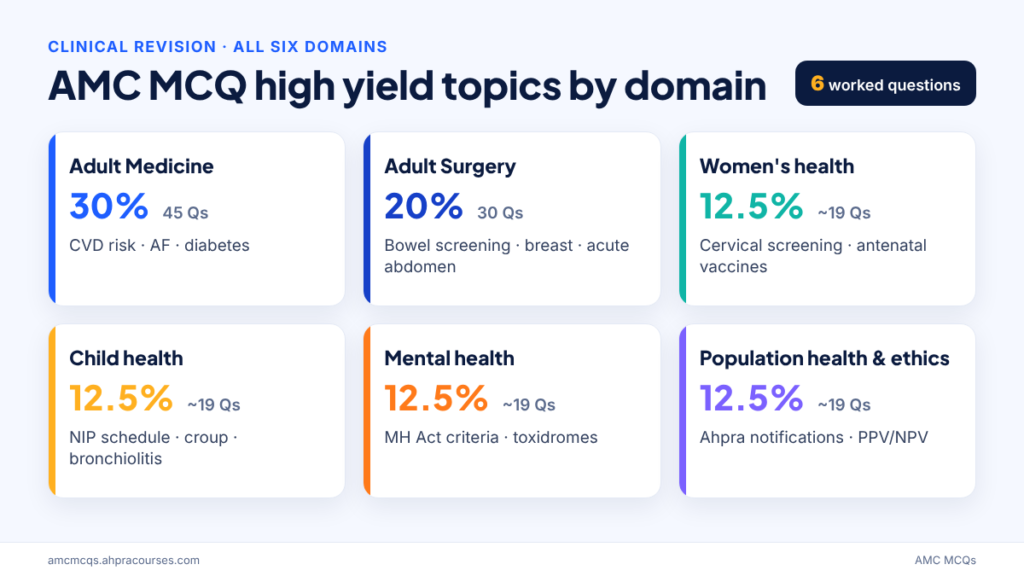
Read the guideThe conditions and Australian-specific decisions most worth mastering in each AMC MCQ domain, with key numbers and six original worked questions.
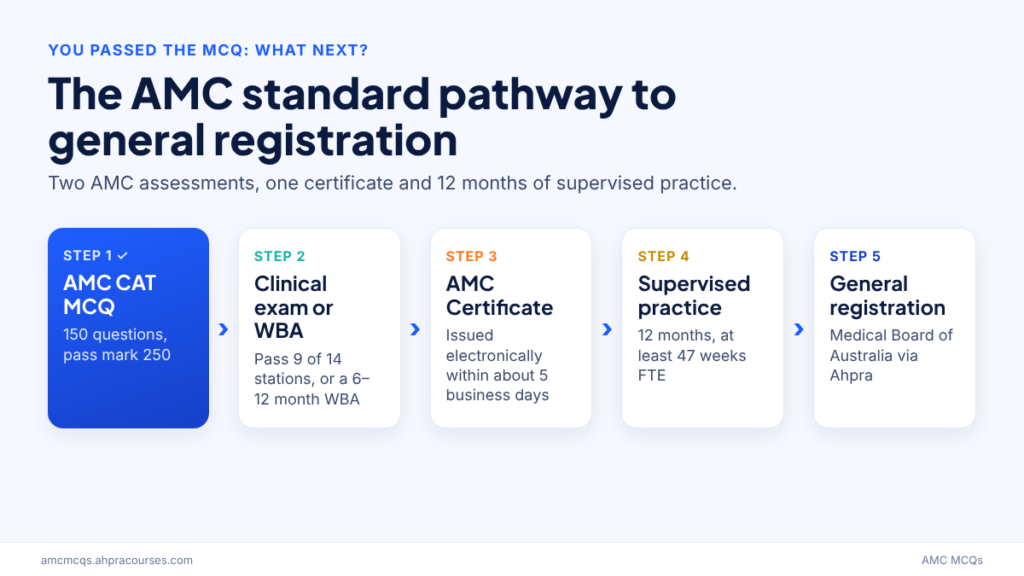
Read the guideWhat happens after you pass the AMC MCQ: the clinical exam or WBA, the AMC Certificate, limited or provisional registration, 12 months of supervised…
Read the guide