Population Health and Ethics in the AMC MCQ: Revision Hub
Population health and ethics is 12.5% of the AMC CAT MCQ, about 19 of 150 questions, covering screening, prevention, communicable disease, Aboriginal and Torres Strait Islander health, biostatistics and Australian medical law. This hub sets out the ages, formulas and legal tests that turn this unfamiliar domain into reliable marks.
Population health and ethics is 12.5% of the AMC CAT MCQ blueprint, so about 19 of your 150 questions will test screening, prevention, communicable disease control, biostatistics, Aboriginal and Torres Strait Islander health, and the law and ethics of everyday practice in Australia. This AMC population health and ethics MCQ hub maps the whole domain and gives you the Australian numbers, legal tests and calculations to learn.
For many IMGs this is the least familiar domain, because screening ages, notification duties, consent law and the Medical Board code are all Australian. Once learned, these are some of the most predictable marks in the exam.
Key takeaways
- Population health and ethics is 12.5% of the blueprint: about 19 questions in a 150-item exam.
- Learn the national screening programs by age and interval: bowel 45–74 every 2 years, breast 50–74 every 2 years, cervical 25–74 every 5 years, lung 50–70 every 2 years for eligible people.
- Biostatistics questions need you to calculate quickly: sensitivity, specificity, PPV, NPV, NNT and relative risk from a 2×2 table.
- The ethics questions rest on Australian law and the Medical Board code: material-risk consent, mature minors, confidentiality exceptions, mandatory notifications and open disclosure.
- Expect an Aboriginal and Torres Strait Islander health angle across the domain: earlier CVD risk assessment, extra vaccines, health assessments and cultural safety.
How population health and ethics is examined in the AMC MCQ
This domain covers both individual patients and populations. Stems tend to take one of four forms:
- Prevention and screening: "Which test should be offered?" or "When should she next be screened?"
- Public health action: "What is the most appropriate next step?" after a notifiable disease, an outbreak or an exposure.
- Calculation and research methods: a 2×2 table, a trial result or a study description, with five numeric or design options.
- Ethical and legal decisions: "What should the doctor do?" about consent, confidentiality, a colleague, an error or end-of-life care.
All three clinician tasks apply: gathering information (checking capacity), interpreting data (reading a trial) and management (notifying, disclosing, referring). In ethics stems, the best answer protects the patient and follows the law, and is often a conversation with the patient before any escalation.
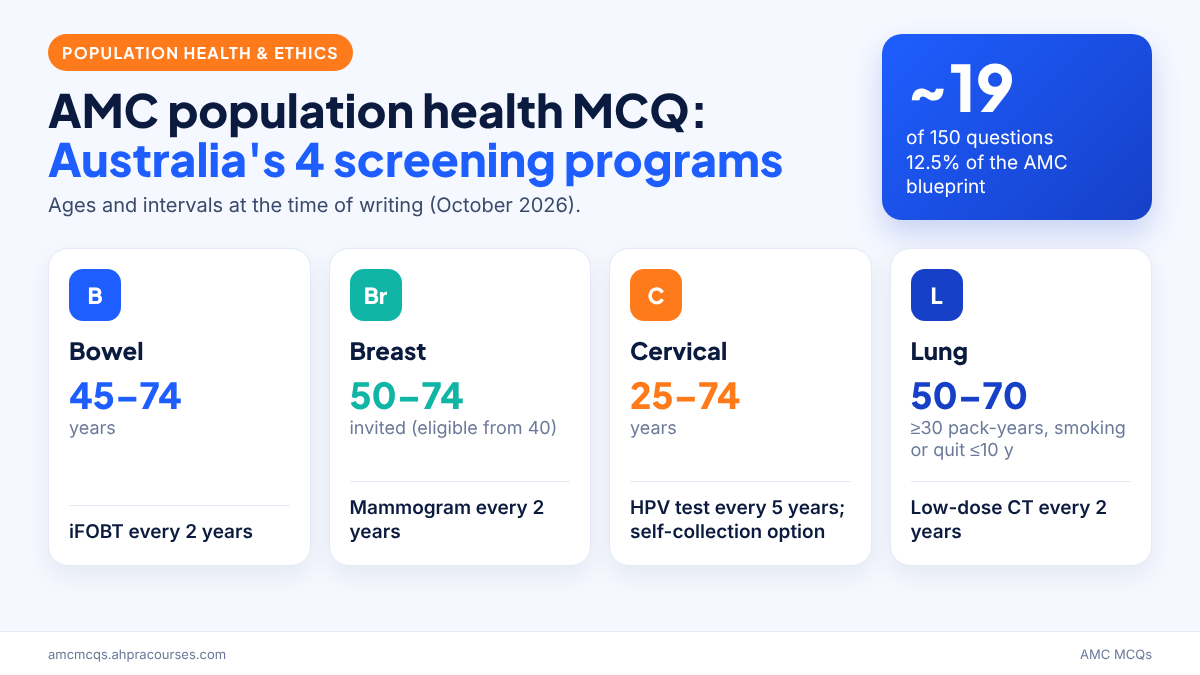
Australian screening programs and screening principles
| Program | Who | Test and interval | Points that get tested |
|---|---|---|---|
| National Bowel Cancer Screening Program | 45–74 years (45–49 can request their first kit) | Immunochemical faecal occult blood test (iFOBT) every 2 years | A positive iFOBT needs colonoscopy, not a repeat FOBT. People with symptoms need investigation, not screening |
| BreastScreen Australia | Invited 50–74; eligible from 40 | Screening mammogram every 2 years | A breast lump is a diagnostic work-up (triple test), not screening |
| National Cervical Screening Program | 25–74 years (women and people with a cervix) | HPV-based Cervical Screening Test every 5 years; self-collection is an option | Postcoital bleeding needs clinical assessment whatever the screening history |
| National Lung Cancer Screening Program (from July 2025) | 50–70, no symptoms, current smoker or quit within 10 years, at least 30 pack-years | Low-dose CT every 2 years | Calculate pack-years: packs per day × years smoked |
The Wilson–Jungner principles explain why programs exist for some conditions and not others:
- The condition is an important health problem with a recognisable early or latent stage.
- There is an acceptable and accurate test.
- An effective treatment exists for disease found early.
- Facilities for diagnosis and treatment are available.
- The benefits outweigh the harms and the cost.
Prostate cancer has no national program: PSA testing is an informed, shared decision.
Exam tip: Lead-time bias (diagnosis is earlier but death is not later), length-time bias (screening picks up slow-growing disease) and overdiagnosis are favourite distractors in "why did survival improve?" questions. Mortality reduction in a randomised trial is the evidence that a screening program works.
Prevention in general practice
Cardiovascular risk
The 2023 Australian guideline and its Aus CVD Risk calculator estimate 5-year risk:
- Who to assess: adults aged 45–79 without known CVD; people with diabetes from 35; Aboriginal and Torres Strait Islander people from 30. For First Nations people aged 18–29, assess individual risk factors.
- Risk categories: high is 10% or more, intermediate is 5% to under 10%, and low is under 5%.
- Management: high-risk patients need lifestyle change plus BP-lowering and lipid-lowering drugs unless contraindicated. Intermediate-risk patients need a shared decision.
Alcohol, smoking and the RACGP Red Book
The NHMRC alcohol guidelines say healthy adults should drink no more than 10 standard drinks a week and no more than 4 on any one day. Under-18s and anyone who is pregnant or planning a pregnancy should not drink. For smoking, every patient should be asked, given brief advice and offered help: pharmacotherapy (nicotine replacement, varenicline) plus referral to Quitline (13 7848). The RACGP's Guidelines for preventive activities in general practice (the Red Book) sets out age-based preventive activities.
Communicable disease control and immunisation
- Notifiable conditions: doctors notify the local public health unit under state public health law. Some conditions, such as measles and meningococcal disease, are notified urgently on clinical suspicion, without waiting for laboratory confirmation.
- Measles post-exposure prophylaxis (NSW Health): MMR within 72 hours of first exposure for contacts aged 6 months or older (not for those who are pregnant or immunocompromised). Normal human immunoglobulin up to 144 hours (6 days) for infants under 6 months, pregnant women and immunocompromised people. Infants aged 6–11 months who receive MMR still need two further doses from 12 months.
- Outbreak steps: confirm the diagnosis and that there really is an outbreak, define a case, find cases and contacts, describe them by time, place and person, put control measures in place, and communicate.
- Adult immunisation highlights: annual influenza (funded for people aged 65 and over, pregnant women, Aboriginal and Torres Strait Islander people from 6 months, and people with risk conditions); pertussis in each pregnancy; recombinant zoster vaccine funded for older adults, First Nations adults and immunocompromised people. Check the current eligibility ages in the Immunisation Handbook.
Aboriginal and Torres Strait Islander health
The Medical Board's code of conduct makes culturally safe practice a professional requirement. Cultural safety is defined by the patient's experience, not the doctor's intentions. What AMC questions expect:
- Ask every patient whether they are of Aboriginal and/or Torres Strait Islander origin. You cannot tell by looking.
- Offer the Medicare-funded Aboriginal and Torres Strait Islander health assessment (MBS item 715) at any age.
- Apply earlier or extra prevention: CVD risk assessment from age 30, extra childhood vaccines (meningococcal B, an additional pneumococcal dose), annual influenza from 6 months, and the Closing the Gap PBS co-payment program.
- Remember acute rheumatic fever and rheumatic heart disease in remote and northern communities. Secondary prophylaxis with regular intramuscular benzathine benzylpenicillin prevents recurrence.
- Involve Aboriginal health workers, use interpreters where needed, and include family if the patient wishes.
Epidemiology and biostatistics for the AMC MCQ
Learn these from a 2×2 table (a = true positive, b = false positive, c = false negative, d = true negative):
| Measure | Formula | What it tells you |
|---|---|---|
| Sensitivity | a / (a + c) | The proportion of people with disease who test positive. High sensitivity rules disease out when the test is negative |
| Specificity | d / (b + d) | The proportion of people without disease who test negative. High specificity rules disease in when the test is positive |
| PPV | a / (a + b) | Rises with prevalence. The same test has a lower PPV in a low-risk population |
| NPV | d / (c + d) | Falls as prevalence rises |
| Absolute risk reduction | Control event rate − treatment event rate | The basis of the NNT |
| NNT | 1 / ARR | Example: ARR 4% → NNT 25 |
| Relative risk | Risk in exposed / risk in unexposed | Used in cohort studies and RCTs |
| Odds ratio | (a × d) / (b × c) | Used in case-control studies |
Study designs and levels of evidence
- NHMRC levels: Level I is a systematic review of RCTs. Level II is an RCT. Level III covers pseudo-randomised and comparative studies. Level IV is a case series.
- Design by question: a rare disease suits a case-control study; a rare exposure or incidence suits a cohort study; prevalence suits a cross-sectional survey; and an intervention calls for an RCT.
- Bias and confounding: selection bias, recall bias (case-control), loss to follow-up (cohort) and confounding. Randomisation controls for known and unknown confounders. Intention-to-treat analysis keeps the benefit of randomisation.
For more worked calculations, see the AMC ethics and population health questions guide.
Ethics and law: the AMC ethics questions decision map
Consent and capacity
- Material risk: since Rogers v Whitaker (1992), Australian doctors must disclose risks that a reasonable person in the patient's position would consider significant, and risks this particular patient would consider significant.
- Capacity is specific to the decision. The patient must understand, retain, weigh and communicate. A capable adult can refuse treatment, including life-sustaining treatment. Where capacity is lacking, look for a valid advance care directive, then the substitute decision-maker the state law names.
- Minors: Australian law accepts mature-minor (Gillick) competence, endorsed by the High Court in Marion's case (1992). A young person who understands the treatment fully can consent to it, for example to contraception. Some decisions, such as sterilisation, need a court.
Confidentiality and its exceptions
Confidentiality can be breached with consent, when the law requires it (notifiable diseases, child protection reporting, a court order), or when there is a serious threat to someone's life, health or safety. Disclose only what is necessary. Fitness-to-drive questions follow the Austroads Assessing Fitness to Drive standards. The doctor advises the patient first. If a patient keeps driving against advice, doctors in every state and territory can report to the driver licensing authority in good faith, and in South Australia and the Northern Territory health professionals have a legal duty to report.
Notifications, errors and professional conduct
- Mandatory notifications to Ahpra cover four concerns: impairment, intoxication while practising, a significant departure from accepted professional standards, and sexual misconduct in connection with practice. If you are the practitioner's treating doctor, the threshold for impairment, intoxication and standards is a substantial risk of harm to the public, so that unwell practitioners can seek care. Sexual misconduct has no such threshold. Treating practitioners in WA are exempt from the mandatory duty.
- Child abuse: doctors are mandatory reporters to state child protection services. The threshold differs by jurisdiction.
- Open disclosure (the national Open Disclosure Framework): after an adverse event, acknowledge it promptly, apologise (saying "sorry" is not an admission of liability), explain the facts, describe the consequences and what will be done to prevent a recurrence, and document the discussion.
- Boundaries and conflicts: sexual relationships with current patients are never acceptable. Avoid treating yourself, family or close colleagues except in emergencies. Declare financial interests. Decline large gifts.
End-of-life care
Withholding or withdrawing treatment that is futile or no longer wanted is lawful and is not euthanasia. Giving opioids for symptom relief at the end of life is appropriate even if it may shorten life, provided the intent is to relieve symptoms. Voluntary assisted dying is now lawful in all six states and, since November 2025, the ACT. Each jurisdiction has strict eligibility rules and processes, and doctors may conscientiously object.
Common traps for IMGs in AMC population health and ethics MCQs
- Screening a symptomatic patient. Rectal bleeding, a breast lump or postcoital bleeding need diagnostic tests, not a screening program.
- Using another country's intervals. Australia uses 5-yearly HPV testing from 25, not 3-yearly cytology.
- Escalating too fast. Before breaching confidentiality or notifying, the best first step is often to talk to the patient or colleague, unless the risk is immediate.
- Telling parents what a mature minor said in confidence without the young person's consent, when there is no serious risk.
- Mixing up relative and absolute risk, or calculating the NNT from a relative risk reduction.
- Assuming PPV is a fixed property of the test. It changes with prevalence.
How to study population health and ethics in our question bank
About one in eight of our 3,000 original questions falls in this domain. Each question explains every option and links the answer to the Australian rule behind it. A suggested routine:
- Memorise the screening table and test yourself with tutor-mode screening questions until you get every age and interval right.
- Do 10 biostatistics questions a day with a whiteboard and pen, as you will have in the test centre. Draw the 2×2 table every time.
- Group ethics questions by theme (consent, confidentiality, notifications, end of life) and write the legal test in one line for each.
- Use the analytics and weak-area drills, then redo the questions you got wrong until you get them right twice.
- Finish with the timed mock exam at 84 seconds a question, because ethics stems can tempt you to overthink.
Start with 10 free population health and ethics questions in the AMC MCQ practice bank, see what each pack includes on the pricing page, read Australian guidelines for the AMC MCQ, and explore the other domains from the AMC MCQ topics hub.
Worked AMC population health and ethics practice questions
A new rapid test for a condition is evaluated in 1,000 adults attending a clinic. 100 of them have the condition on the reference standard. The test has a sensitivity of 90% and a specificity of 80%. What is the positive predictive value of the test in this population?
- 9%
- 33%
- 80%
- 90%
- 98.6%
Show answer and explanation
Answer: B. Of 100 people with the condition, 90 test positive (true positives) and 10 test negative. Of 900 without it, 80% (720) test negative, so 180 are false positives. PPV = 90 / (90 + 180) = 90 / 270 ≈ 33%. Option E is the NPV: 720 / (720 + 10) ≈ 98.6%. Options D and C are the sensitivity and specificity, which describe the test, not the meaning of a positive result. Option A is the true-positive count as a percentage of the whole sample. The low PPV, despite a good test, reflects the 10% prevalence.
You are the GP of a 41-year-old anaesthetist who tells you she has been misusing opioids taken from work for 3 months. She has already stopped clinical work, taken leave and started treatment with an addiction medicine specialist. She agrees not to return to practice until cleared, and you have no reason to doubt her. She is not in Western Australia. What is the most appropriate action regarding notification?
- Notify Ahpra today because opioid misuse must always be reported
- Inform her hospital employer so it can audit drug registers
- Continue treatment; mandatory notification is not required now
- Notify Ahpra only if she relapses while on leave from work
- Ask the police to investigate the removal of drugs from work
Show answer and explanation
Answer: C. As her treating practitioner, you must make a mandatory notification only if her impairment places the public at substantial risk of harm. She has stopped practising, is engaged in treatment and has agreed not to return until cleared, so the risk to the public is not substantial at present. Continue treatment and keep reassessing: notification would be needed if she returned to practice while impaired. Option A misstates the law, because impairment alone does not trigger a notification. Telling her employer (B) or the police (E) without consent breaches confidentiality and is not legally required here. Option D is too rigid, because relapse while off work does not by itself create a risk to the public. What matters is whether she practises while impaired. You may still make a voluntary notification if you judge it necessary.
AMC population health and ethics MCQ: frequently asked questions
How many population health and ethics questions are in the AMC MCQ?
Population health and ethics is 12.5% of the AMC blueprint, about 19 of the 150 questions. Because some items are unscored new questions, the exact number that counts towards your result varies.
Which Australian screening programs should I memorise for the AMC exam?
Learn the four national cancer programs: bowel (iFOBT every 2 years, 45–74), breast (mammogram every 2 years, invited 50–74), cervical (HPV test every 5 years, 25–74) and lung (low-dose CT every 2 years for eligible people aged 50–70 with heavy smoking histories).
Do AMC ethics questions test Australian law or general principles?
Both, but the answers follow Australian law and the Medical Board's code of conduct: material-risk consent from Rogers v Whitaker, mature-minor competence, mandatory reporting duties, Ahpra mandatory notifications and the national open disclosure framework.
Are biostatistics calculations really tested in the AMC CAT MCQ?
Yes. Expect sensitivity, specificity, PPV, NPV, NNT and relative or absolute risk, usually from a short scenario. You get a whiteboard and pen in the test centre, so practise drawing a 2×2 table quickly.
When must a treating doctor notify Ahpra about a practitioner-patient?
A treating practitioner must notify when a practitioner-patient's impairment, intoxication or departure from standards places the public at substantial risk of harm, or for sexual misconduct connected with practice. Treating practitioners in Western Australia are exempt from the mandatory requirement.
How should I revise this domain if ethics is new to me?
Write a one-line legal test for each theme, practise grouped questions in tutor mode, then mix them into timed blocks. Most ethics answers involve talking to the patient first, putting safety first, and the least intrusive lawful action.
Free sample Pop. health & ethics questions from our bank
Three questions from the bank, shown with answers. Sign up free for ten more in this domain, in tutor mode.
Sample 1: Study designs
At a regional agricultural show in Queensland, 1200 adults complete a questionnaire on current smoking and have their blood pressure measured on the same day. Hypertension is more common in current smokers than in non-smokers. What is the main limitation of this design for inferring that smoking causes hypertension?
Answer: E. This is a cross-sectional study, a snapshot in which exposure and outcome are measured simultaneously. Because it is unclear which came first, it cannot establish temporality, one of the key criteria for causation, and it tends to over-represent long-duration cases. Cross-sectional studies are quick and good for estimating prevalence and health service planning.
Learning point: Cross-sectional studies measure prevalence but cannot establish temporal sequence between exposure and outcome.
Sample 2: Absolute risk reduction
A 5-year randomised trial of a new lipid-lowering drug in Australian adults with established coronary disease reports major cardiovascular events in 10% of the placebo group and 7% of the treatment group. What is the absolute risk reduction?
Answer: A. ARR = control event rate - experimental event rate = 0.10 - 0.07 = 0.03, i.e. 3.0% over 5 years. The RRR is 0.03/0.10 = 30% and the NNT is 1/0.03 = 33.3, rounded up to 34 over 5 years. The ARR, unlike the RRR, conveys the actual size of benefit for an individual patient.
Learning point: Absolute risk reduction = control event rate - experimental event rate.
Sample 3: Study designs
Researchers compare per-capita sales of sugar-sweetened beverages across Australian states and territories with each jurisdiction's prevalence of type 2 diabetes, finding a strong positive correlation (r = 0.82). A media release states that individuals who drink more soft drink are at higher risk of diabetes. What is the main problem with this conclusion?
Answer: D. This is an ecological study because both exposure and outcome are measured as population averages rather than for individuals. Inferring individual-level risk from group-level correlations is the ecological fallacy: we do not know whether the people drinking more soft drink are the same people who have diabetes. Ecological studies are useful for generating hypotheses, which should then be tested in individual-level cohort or case-control studies.
Learning point: Ecological studies use group-level data and cannot support conclusions about individual risk (ecological fallacy).
Subtopics in our Pop. health & ethics question bank
Number of questions per subtopic. Your dashboard tracks your accuracy in each one.
- Adult National Immunisation Program 8
- Contact tracing 8
- National screening programs 8
- Absolute cardiovascular risk assessment 7
- Alcohol guidelines 7
- Health promotion models 7
- Medicare and PBS 7
- Notifiable diseases and public health units 7
- Occupational health and workplace injury 7
- Outbreak investigation 7
- Physical activity and obesity prevention 7
- RACGP Red Book preventive activities 7
- Refugee and migrant health screening 7
- Rheumatic heart disease and acute rheumatic fever 7
- Smoking cessation and vaping 7
- Travel medicine 7
- 715 health assessment 6
- Aboriginal Community Controlled Health Services 6
- Absolute risk reduction 6
- Aged care and My Aged Care 6
- Bias and confounding 6
- Capacity assessment 6
- Chronic disease burden 6
- Closing the Gap 6
- Confidentiality and its exceptions 6
- Cultural safety 6
- Disability and the NDIS 6
- Health workforce 6
- Incidence and prevalence 6
- Informed consent 6
- Levels of evidence and critical appraisal 6
- Likelihood ratios 6
- Minors and Gillick competence 6
- Number needed to treat and harm 6
- Odds ratio 6
- Otitis media and hearing in Aboriginal children 6
- P-values and confidence intervals 6
- Positive and negative predictive value 6
- Private vs public health system 6
- Relative risk 6
Unlock the full Pop. health & ethics bank
Every pack includes this domain in its blueprint share, plus timed blocks and the full mock exam.
500 questions
About A$10 per 100 questions
- Every domain in AMC blueprint proportions
- Full explanation for every option
- Tutor and timed modes
- Full 150-question mock exam
1,000 questions
About A$10 per 100 questions
- Everything in the 500 pack
- Twice the practice for a full study cycle
- Weak-area drills and redo-incorrect
- Bookmarks and full history
3,000 questions
About A$10 per 100 questions
- The complete 3,000-question bank
- Includes every question in the 500 and 1,000 packs
- Best value per question
- Mock exam drawn from all 3,000 questions
One payment, no subscription. Higher packs include every question from the smaller packs.