AMC MCQ Exam Fees, Booking Steps and Exam Dates Explained
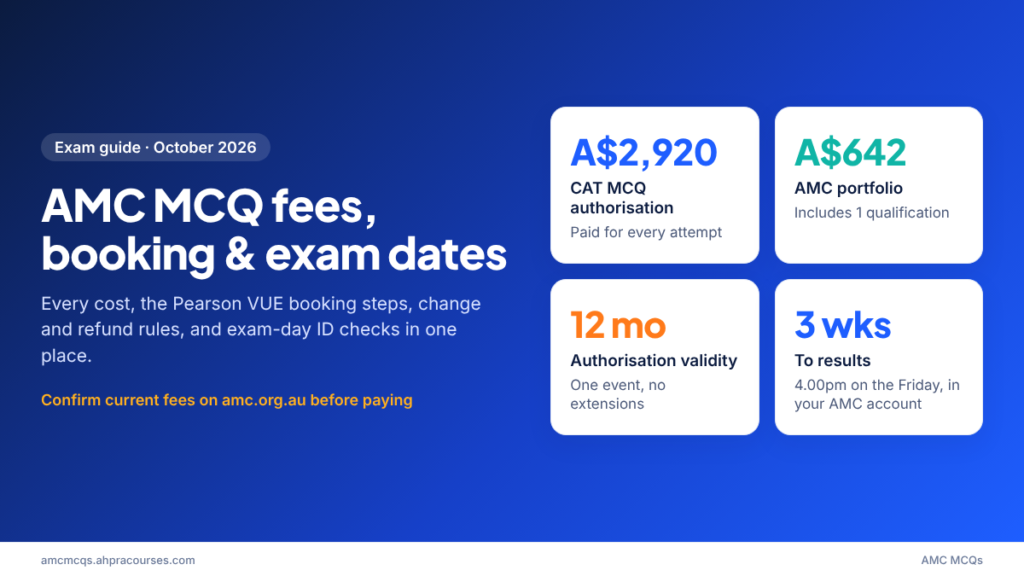
Every AMC MCQ cost in one place, from the A$642 portfolio and A$2,920 authorisation to ECFMG verification, plus step-by-step Pearson VUE booking, change and…
Read the guideThe conditions and Australian-specific decisions most worth mastering in each AMC MCQ domain, with key numbers and six original worked questions.
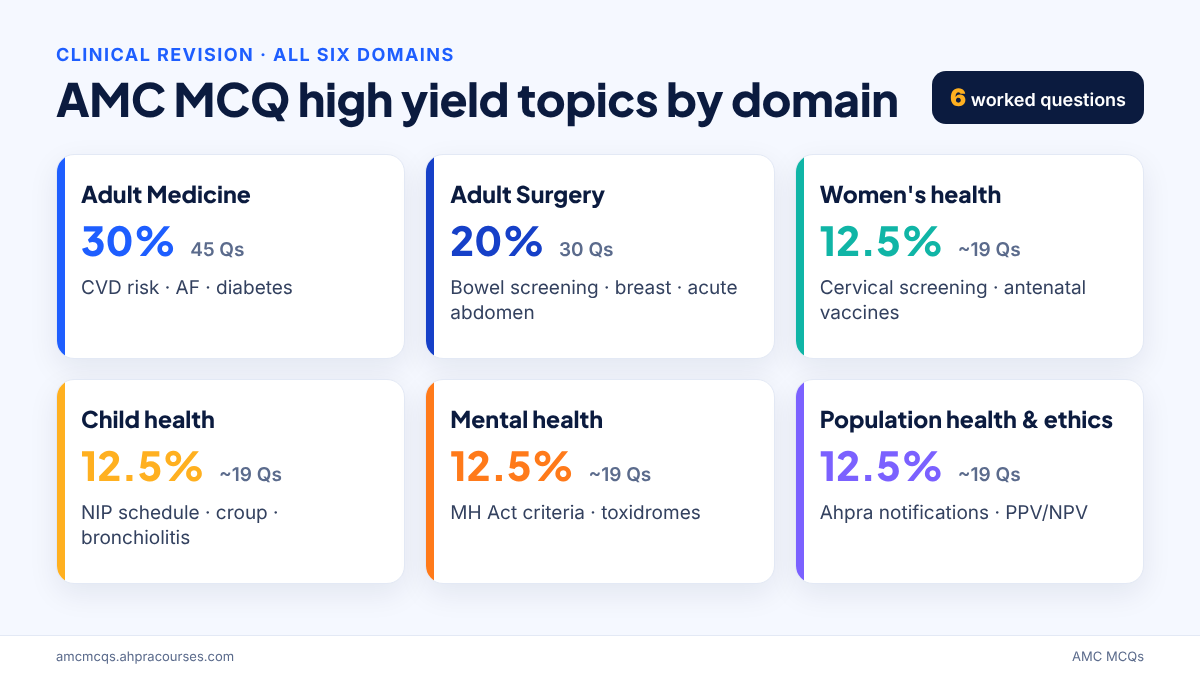
With 150 questions spread across six patient groups, you cannot study every condition in equal depth. The AMC MCQ high yield topics are the ones that are common in the Australian community, carry a clear “next best step”, and have an Australian-specific answer that differs from what many IMGs learned at home. This guide works through each domain of the blueprint, lists the conditions and decisions most worth mastering with the key numbers, and finishes each domain with an original worked question.
The AMC’s examination specifications give you three clues about what is high yield:
Every question also tests one of three clinician tasks: data gathering, data interpretation and management. For each topic below, ask yourself all three.
| Domain | Weight | About how many questions | Highest-yield themes |
|---|---|---|---|
| Adult health – Medicine | 30% | 45 | CVD risk, AF, diabetes, chest pain, visual loss, coeliac disease, adverse drug effects |
| Adult health – Surgery | 20% | 30 | Bowel screening, breast lumps, acute abdomen, open fractures, skin cancer, soft-tissue infection |
| Women’s health | 12.5% | about 19 | Cervical screening, antenatal vaccines, GDM, early pregnancy bleeding, reduced fetal movements |
| Child health | 12.5% | about 19 | Immunisation schedule, croup, bronchiolitis, febrile infant, neonatal resuscitation |
| Mental health | 12.5% | about 19 | Compulsory treatment criteria, suicide risk, toxidromes, lithium, adolescent depression |
| Population health and ethics | 12.5% | about 19 | Mandatory notifications, confidentiality, consent, screening statistics, alcohol guidelines |
If you have not yet mapped these domains onto a timetable, use our AMC MCQ study plan, which splits your hours by the same weights.
Australia uses absolute risk, not single risk factors, to decide on blood pressure and lipid treatment. The 2023 Australian guideline and its calculator (Aus CVD Risk) recommend assessment for:
Risk is reported as 5-year risk: high ≥10%, intermediate 5% to under 10%, low under 5%. If a stem gives you a 50-year-old with a single raised reading and asks what to do next, the answer is often “calculate absolute risk”, not “start a drug”.
The Australian AF guideline (National Heart Foundation and CSANZ) uses the sex-neutral CHA2DS2-VA score: heart failure 1, hypertension 1, age ≥75 2, diabetes 1, prior stroke/TIA/thromboembolism 2, vascular disease 1, age 65–74 1.
Exam tip: IMGs trained on CHA2DS2-VASc often add a point for female sex. The Australian score drops it, so a 66-year-old woman with no other risk factors scores 1, not 2.
From the RACGP and Diabetes Australia handbook:
A 70-year-old woman sees her GP with palpitations. An ECG confirms atrial fibrillation with a ventricular rate of 88 per minute. She has treated hypertension and no other medical history. Her renal function is normal and she has no bleeding risk factors. What is the most appropriate management to reduce her stroke risk?
Answer: C. Her CHA2DS2-VA score is 2 (age 65–74 = 1, hypertension = 1), so the Australian guideline recommends oral anticoagulation, and a NOAC such as apixaban is preferred over warfarin. Aspirin (A) and dual antiplatelet therapy (E) are not recommended for AF stroke prevention. No treatment (B) fits a score of 0. Warfarin (D) is effective but not preferred when a NOAC can be used; it is reserved for situations such as dialysis.
The triple test is the Australian standard for any breast change: clinical assessment, imaging (mammogram and/or ultrasound) and non-excision biopsy (fine-needle aspiration or core biopsy). A bloody or spontaneous single-duct nipple discharge needs the same work-up. BreastScreen Australia invites women aged 50–74 every 2 years, but screening is not for women with symptoms.
Australia has one of the highest melanoma rates in the world. Know the features of melanoma (asymmetry, irregular border, colour variation, change), and that a suspicious pigmented lesion is managed by excision biopsy with a narrow margin, not a shave or partial punch. Recognise basal cell and squamous cell carcinoma.
| Presentation | Clue in the stem | First steps |
|---|---|---|
| Open fracture | Wound over a fracture | IV antibiotics as soon as possible, tetanus status, photograph and cover the wound, splint, urgent theatre for debridement |
| Necrotising soft-tissue infection | Rapid spread, pain out of proportion, systemic toxicity | Resuscitation, broad-spectrum IV antibiotics, urgent surgical debridement |
| Deep neck space infection | Trismus, drooling, neck swelling, voice change | Airway first, senior anaesthetic and ENT help, IV antibiotics, imaging when safe |
| Ruptured AAA | Older smoker, back or abdominal pain, hypotension, pulsatile mass | Permissive hypotension, immediate vascular surgery |
| Acute mesenteric ischaemia | AF, pain far worse than abdominal signs, raised lactate | CT angiography and urgent surgical review |
| Testicular torsion | Sudden severe testicular pain in an adolescent | Urgent surgical exploration; do not delay for ultrasound |
Also revise post-operative complications by day, trauma priorities and the Ottawa ankle and knee rules.
A 58-year-old man returns his National Bowel Cancer Screening Program kit and the result is positive. He has no symptoms, no family history of bowel cancer, and his haemoglobin and examination are normal. What is the most appropriate next step?
Answer: E. A positive screening iFOBT needs follow-up, and colonoscopy is the usual next step because it can find and remove polyps or cancers. Repeating the test (A) or rescreening (B) wrongly treats a positive result as reassuring. CEA (C) is a tumour marker for monitoring known disease, not a diagnostic or screening test. CT (D) does not allow biopsy or polypectomy and is not the first-line follow-up of a positive iFOBT.
The National Cervical Screening Program uses an HPV-based Cervical Screening Test:
A 34-year-old woman chooses self-collection for her routine Cervical Screening Test. She has no symptoms. The result shows HPV type 16 detected. What is the most appropriate next step?
Answer: A. When HPV 16 or 18 is detected, the National Cervical Screening Program recommends referral for colposcopy, whatever the collection method; cytology can be taken at colposcopy. Returning for clinician-collected cytology (B) is the pathway for HPV types other than 16/18 on a self-collected sample. A 12-month repeat (C) applies to some lower-risk results, not HPV 16/18. Repeating self-collection (D) adds nothing, and routine screening (E) applies only when HPV is not detected.
| Age | Funded vaccines (all children) |
|---|---|
| Birth | Hepatitis B |
| 2 months (from 6 weeks) | DTPa–hepatitis B–polio–Hib, rotavirus, pneumococcal conjugate |
| 4 months | DTPa–hepatitis B–polio–Hib, rotavirus, pneumococcal conjugate |
| 6 months | DTPa–hepatitis B–polio–Hib (plus extra doses for specified medical risk conditions) |
| 12 months | MMR, pneumococcal conjugate, meningococcal ACWY |
| 18 months | MMRV (measles, mumps, rubella, varicella), DTPa, Hib |
| 4 years | DTPa–polio |
| 12–13 years (Year 7) | HPV, dTpa |
| 14–16 years (Year 10) | Meningococcal ACWY |
Annual influenza vaccine is funded for all children aged 6 months to under 5 years. Aboriginal and Torres Strait Islander children receive extra funded vaccines: meningococcal B at 2, 4 and 12 months, an extra pneumococcal dose at 6 months, annual influenza at every age from 6 months, and in WA, NT, SA and Qld hepatitis A doses. Pregnant women are offered the RSV vaccine at 28–36 weeks, and states also run infant RSV immunisation programs. Check the current schedule on health.gov.au before you sit, because programs change.
Australian guidance from the Royal Children’s Hospital Melbourne grades croup by work of breathing and behaviour, not by how loud the stridor is:
A 5-month-old girl has had a runny nose and cough for 3 days. She is now taking about a third of her usual feeds and has fewer wet nappies. She has a respiratory rate of 56, mild subcostal recession and widespread crackles. Her oxygen saturation is 93% on room air. What is the most appropriate management?
Answer: D. This is bronchiolitis with poor feeding and early dehydration, so she needs hydration support; nasogastric fluids are the preferred route. Salbutamol (A) and corticosteroids (B) are not recommended in bronchiolitis. Oxygen (C) is started only when saturations are persistently below 90%. Chest X-ray and antibiotics (E) are not indicated in typical bronchiolitis and lead to unnecessary treatment.
Each state and territory has its own Act, with shared principles. Under Victoria’s Mental Health and Wellbeing Act 2022 (in force from 1 September 2023), all four criteria must be met for a compulsory treatment order:
Family consent, a history of violence, or lack of insight alone do not make treatment involuntary.
| Condition | Typical cause | Onset | Key distinguishing signs |
|---|---|---|---|
| Serotonin toxicity | SSRIs, SNRIs, tramadol, MAOIs, combinations | Hours | Clonus (inducible, ocular), hyperreflexia, tremor, agitation, mydriasis, diarrhoea |
| Neuroleptic malignant syndrome | Antipsychotics (or stopping dopamine agonists) | Days | Lead-pipe rigidity, slowed reflexes, hyperthermia, raised CK, altered consciousness |
| Lithium toxicity | Dehydration, NSAIDs, ACE inhibitors, thiazides | Days | Coarse tremor, ataxia, vomiting, confusion, seizures |
| Cocaine or amphetamine intoxication | Stimulant use | Minutes to hours | Hypertension, chest pain, hyperthermia, agitation, mydriasis |
| Opioid withdrawal | Stopping heroin or other opioids | Hours to a day | Yawning, lacrimation, rhinorrhoea, piloerection, cramps, diarrhoea, mydriasis |
A 28-year-old man with a first episode of psychosis believes his neighbours are poisoning his food. He has eaten very little for a week, has lost 5 kg and refuses admission or medication. He has no history of violence. Under Australian mental health legislation, which of the following must be established before he can be placed on a compulsory treatment order?
Answer: B. Australian mental health Acts require that no less restrictive means of treatment is available, alongside mental illness and a need for immediate treatment to prevent serious deterioration or harm. A previous voluntary admission (A) is irrelevant. Family consent (C) cannot authorise involuntary treatment of an adult. Violence (D) is not required: serious deterioration in health, as here, is enough. Lack of insight (E) alone is not a legal criterion.
This domain is often under-studied by IMGs, yet its rules are concrete and learnable. For a deeper treatment, read our guide to AMC ethics and population health questions.
There are four types of notifiable conduct: impairment, intoxication while practising, significant departure from accepted professional standards and sexual misconduct. For a treating practitioner, the threshold for impairment, intoxication and departure from standards is a substantial risk of harm to the public, a very high bar. Sexual misconduct has a lower threshold. In Western Australia, treating practitioners are exempt from mandatory notification, but may notify voluntarily.
Example: a test with 90% sensitivity and 95% specificity in 10,000 people, prevalence 2%.
| Disease present (200) | Disease absent (9,800) | |
|---|---|---|
| Test positive | 180 (true positive) | 490 (false positive) |
| Test negative | 20 (false negative) | 9,310 (true negative) |
You are the GP of a 45-year-old anaesthetist in New South Wales who has major depression. She has engaged well with treatment, her symptoms are improving on medication and psychological therapy, and on your advice she has taken two weeks of leave. There is no evidence that she has practised while impaired. What is your obligation regarding notification to Ahpra?
Answer: C. For a treating practitioner, notification about impairment is required only if there is a substantial risk of harm to the public. A well-managed illness without impaired practice does not meet that threshold. Having a mental illness (A) is not itself notifiable. Telling her employer (B) would breach confidentiality. Refusing medication (D) is not an automatic trigger; the test remains substantial risk of harm. There is no rule (E) requiring her to self-report in this situation.
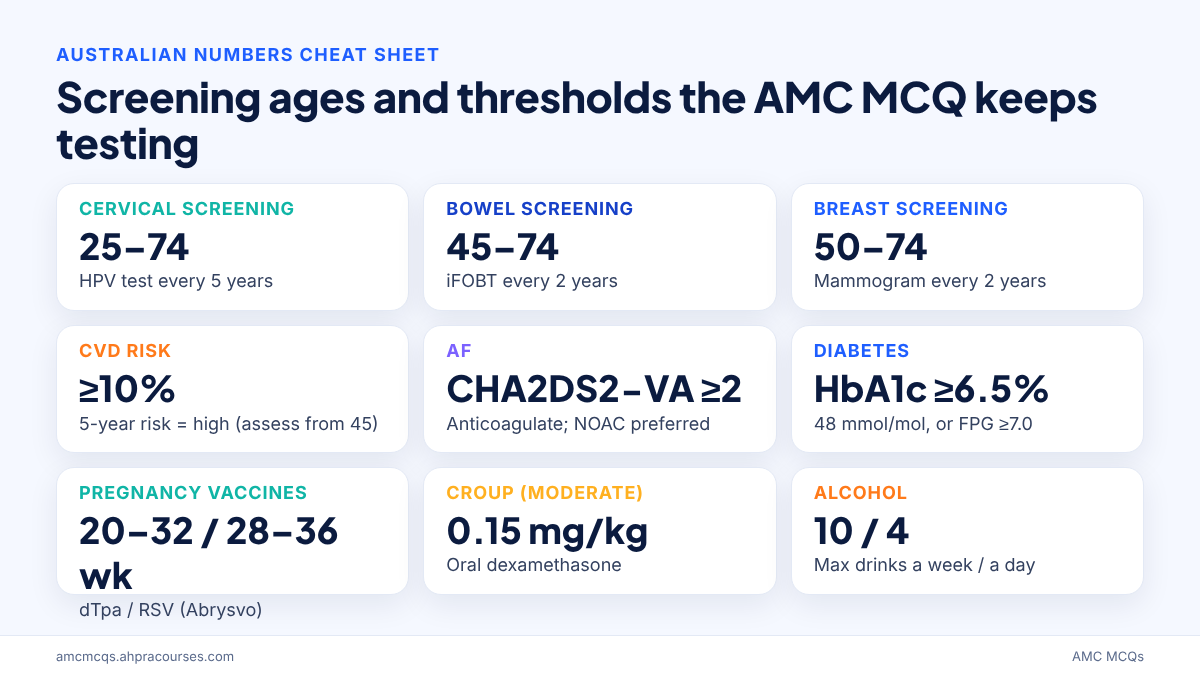
These numbers recur across several domains. Learn them as one set.
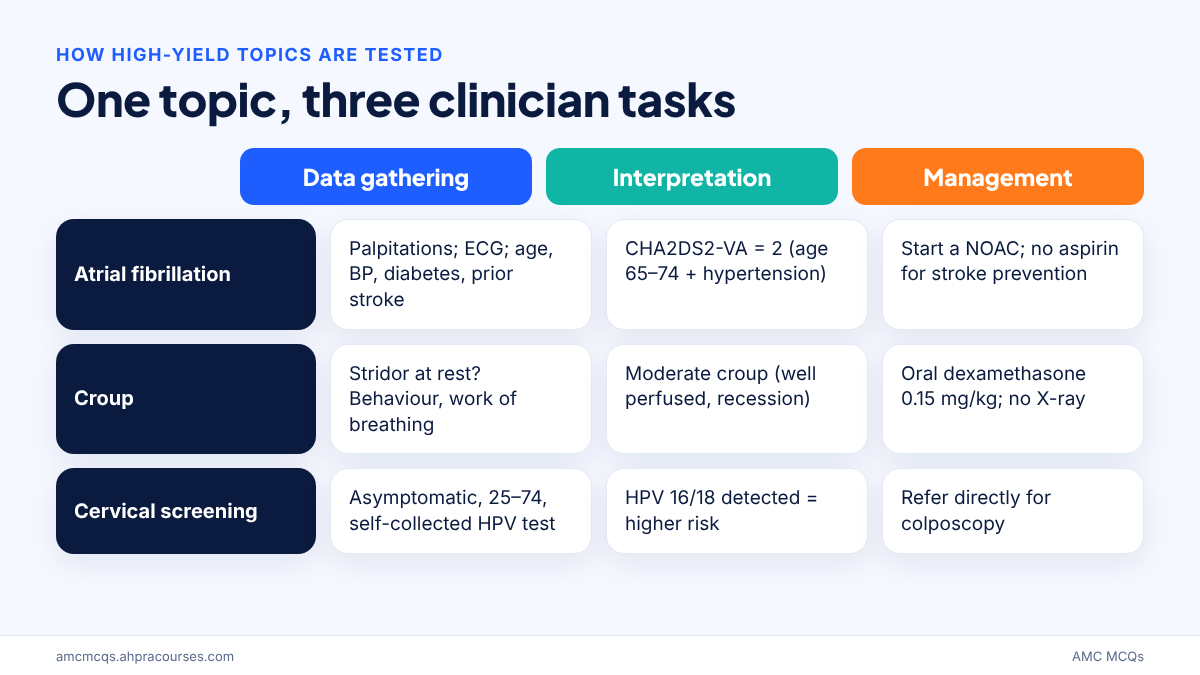
For format and scoring, read the AMC MCQ exam guide, then drill each domain from the AMC MCQ topics hub.
Focus on common Australian presentations with a clear next step: cardiovascular risk, AF, diabetes, the acute abdomen, bowel and cervical screening, antenatal care, the immunisation schedule, croup and bronchiolitis, mental health law and toxidromes, and ethics rules such as mandatory notifications and confidentiality.
Adult Medicine is 30% of the blueprint, about 45 of 150 questions. Adult Surgery is 20% (about 30). Women’s health, Child health, Mental health, and Population health and ethics are 12.5% each, about 19 questions.
Yes. The exam is set at the standard of a new Australian graduate, and most questions reflect common conditions in the Australian community. Screening programs, the National Immunisation Program, Therapeutic Guidelines and Australian risk tools are frequently tested.
Yes. It is 12.5% of the blueprint, about 19 questions. The content (mandatory notifications, consent, confidentiality, screening statistics) is concrete, so it is one of the best places to gain marks with focused study.
No. The AMC states that many reconstructed papers circulating online contain incorrect stems and answers. Use the official specifications and sample questions, the AMC preparation app, original question banks and current Australian guidelines.
Answer exam-style AMC MCQs on this topic with an explanation for every option. 60 questions are free.
Every AMC MCQ cost in one place, from the A$642 portfolio and A$2,920 authorisation to ECFMG verification, plus step-by-step Pearson VUE booking, change and…
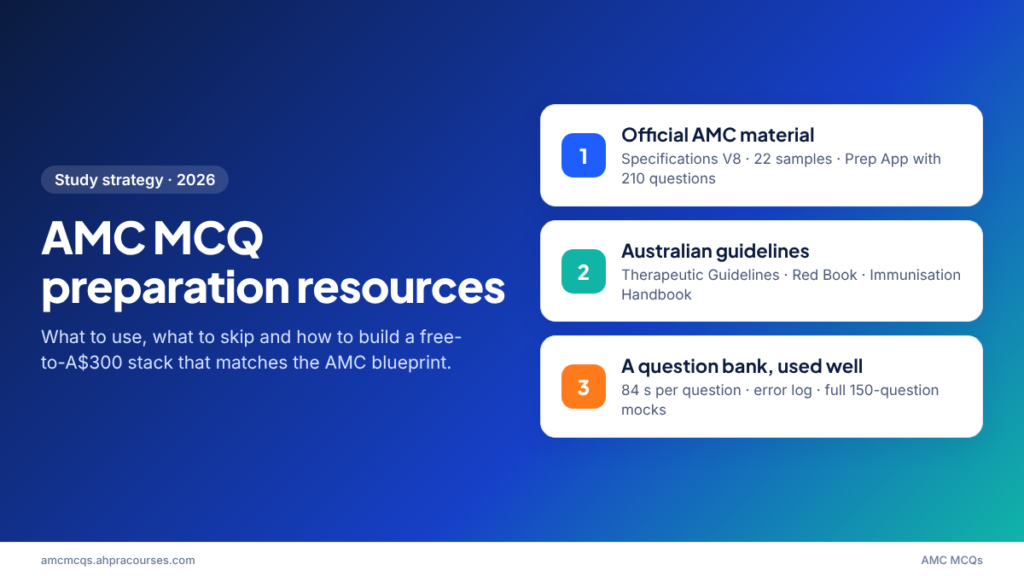
Read the guideWhich AMC MCQ preparation resources are worth your time: the official AMC specifications and app, the Australian guidelines that decide the best answer, how…
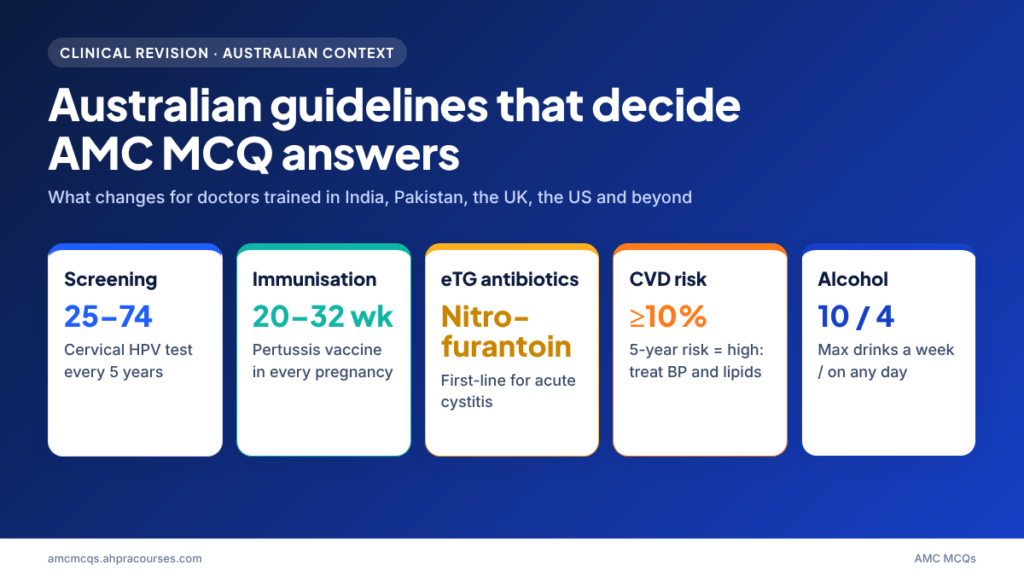
Read the guideThe Australian screening, immunisation, antibiotic, cardiovascular risk, alcohol, Medicare and mental health rules that decide AMC MCQ answers, with tables and worked questions.
Read the guide